





To reduce microbial contamination in healthcare, control every point at which microorganisms can enter, survive or move through the care environment. Effective controls include hand hygiene, cleaning before disinfection, risk-based device reprocessing, appropriate single-patient-use components, respiratory filtration, clean storage and routine auditing. No antimicrobial material, filter or disinfectant can replace this layered approach.
Microbial contamination occurs when hands, medical equipment, respiratory components or environmental surfaces carry potentially infectious microorganisms. Contamination does not automatically mean that an infection will develop, but it creates an opportunity for microorganisms to move between equipment, patients and healthcare workers.
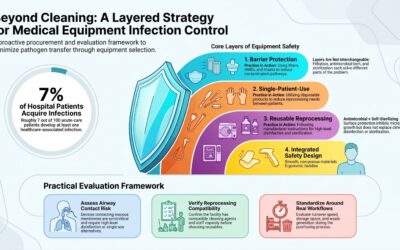
Direct Answer: Reducing microbial contamination means interrupting a chain of transfer rather than cleaning harder. The controls that matter are hand hygiene at the point of care, cleaning before disinfection, reprocessing matched to how the device contacts the patient, correctly specified respiratory filters, single-patient-use components used as labelled, separated clean and contaminated workflows, and auditing that measures whether those steps actually happen.
How to Reduce Microbial Contamination at Each Transfer Point
Microbial contamination is best managed as a chain of transfer rather than an isolated cleaning problem. A contaminated surface becomes clinically significant when microorganisms can move from that surface to hands, equipment, a mucous membrane, non-intact skin or another route into the body.
Canadian routine practices apply to every patient, regardless of diagnosis or known infection status. These practices recognize that microorganisms can be transmitted by symptomatic and asymptomatic individuals.[1]
Transfer Points, Common Failures and Primary Controls
| Transfer point | Common failure | Primary control |
|---|---|---|
| Healthcare worker hands | Handling clean equipment after touching contaminated surfaces | Point-of-care hand hygiene |
| Shared medical equipment | Moving equipment between patients without complete reprocessing | Cleaning and disinfection between patients |
| Airway components | Reusing patient-contact components or selecting an unsuitable filter | Correctly specified filters, circuits and single-patient-use components |
| Connectors and junctions | Repeated handling, disconnection or fluid exposure | Minimize manipulation and use compatible components |
| Environmental surfaces | Incomplete cleaning or insufficient disinfectant contact time | Written cleaning schedules and validated disinfectant use |
| Clean supply areas | Clean and contaminated items stored or transported together | Physical separation and clear equipment status |
| Reusable devices | Incorrect disassembly, cleaning or sterilization | Manufacturer-validated reprocessing instructions |
Key takeaway: The highest-risk points are not always the largest surfaces. Connectors, handles, controls, sampling ports and other frequently handled components may create more transfer opportunities than a visibly soiled but rarely touched surface.
Start With the Device’s Clinical Use, Not the Disinfectant
The required level of reprocessing depends on where and how the device is used. Selecting a disinfectant before determining the device classification can result in either inadequate microbial control or unnecessary processing that damages the equipment.
The Spaulding classification organizes medical devices into three risk categories.[2]
Spaulding Classification and Minimum Reprocessing Level
| Classification | Patient contact | Minimum reprocessing level |
|---|---|---|
| Non-critical | Intact skin or no direct patient contact | Cleaning followed by low-level disinfection, although cleaning alone may be acceptable in limited situations |
| Semi-critical | Mucous membranes or non-intact skin without penetration | Cleaning followed by high-level disinfection at minimum; sterilization is preferred where appropriate |
| Critical | Sterile tissue or the vascular system | Thorough cleaning followed by sterilization |
Respiratory therapy and anesthesia equipment may be classified as semi-critical when components contact mucous membranes. External controls and monitoring surfaces may be non-critical. Classification therefore needs to occur at the component level rather than treating an entire system as one item.
Clinical note: Reusable devices must be processed according to the manufacturer’s written instructions. These instructions should define disassembly, cleaning agents, disinfectant compatibility, exposure time, rinsing, drying, inspection and any validated sterilization method.[3]
Cleaning and Disinfection Are Separate Controls
Cleaning physically removes soil and organic material. Disinfection inactivates many disease-producing microorganisms but does not necessarily destroy bacterial spores. Medical equipment must be adequately cleaned before effective disinfection can occur.[4]
This distinction matters because blood, secretions, protein deposits and other organic material can shield microorganisms from a disinfectant. Applying more disinfectant does not correct inadequate cleaning.
A reliable process should address:
- Correct product: Use a healthcare-appropriate disinfectant with a Health Canada drug identification number and claims suitable for the intended application.
- Device compatibility: Confirm that the chemical will not damage plastics, seals, electronics, displays or coatings.
- Dilution: Prepare concentrated products exactly as labelled.
- Contact time: Keep the surface wet for the full labelled period required for disinfection.[4]
- Coverage: Wipe seams, controls, handles, cables and connection points rather than only broad external surfaces.
- Drying: Complete any required rinsing and drying before the equipment returns to service.
- Documentation: Make the item’s clean or contaminated status immediately identifiable.
Procurement note: Using an incompatible disinfectant can cloud screens, weaken tubing, degrade seals or create surface cracks where soil becomes harder to remove. Evaluate cleanability and disinfectant compatibility before equipment is purchased, not after.
Hand Hygiene Must Surround Equipment Handling
Clean equipment can be recontaminated within seconds when handled with contaminated hands or gloves. Point-of-care alcohol-based hand rub is the expected standard of care in Canadian healthcare settings when hands are not visibly soiled and no situation requiring soap and water applies.[1]
Hand hygiene moments in the equipment workflow
- Before assembling a breathing circuit or handling a clean patient-contact component
- Before performing an aseptic procedure
- After contact with the patient or patient environment
- After handling used equipment
- After removing gloves
- Before returning reprocessed equipment to clean storage
Key takeaway: Gloves provide task-specific protection but do not replace hand hygiene. Hands can become contaminated through glove defects or during glove removal.[1]
Airway and Respiratory Equipment Require Layered Protection
Airway equipment presents several contamination pathways at once. Components may contact respiratory secretions, carry exhaled gas, collect moisture and require manipulation close to the patient’s airway. The terminology used for these components should be interpreted carefully — the names are not interchangeable.
Respiratory component terminology
Bacterial/viral filter
Designed to reduce microbial passage through the breathing pathway.
Heat and moisture exchanger (HME)
Conserves heat and humidity. Should not be assumed to provide microbial filtration.
HMEF
Combines humidification and filtration functions in one device.
Antimicrobial circuit
Inhibits microbial growth on the product material. Not necessarily a substitute for an airway filter.
Single-patient-use component
Assigned to one patient and not to be transferred to another.
Published bacterial or viral filtration efficiency is only one selection criterion. A respiratory filter must also be evaluated for resistance, internal volume or dead space, moisture performance, fluid resistance, connection compatibility and suitability for adult, paediatric or neonatal use.
Important limitation: The effect of dead space and resistance becomes particularly important for smaller patients and lower tidal volumes. The product with the highest filtration percentage is not automatically the most appropriate product for every clinical application.
For a fuller treatment of where antimicrobial materials fit alongside filtration, see BioCote® Protection in Medical Breathing Circuits.
Single-Patient-Use and Reusable Products Solve Different Problems
Single-patient-use components prevent a device from moving between patients, but only when the product is used and discarded as labelled. Reusable products can also be used safely when their design supports validated, repeatable reprocessing. Neither category is inherently safer — each depends on a different process holding up under real workload.
What each option depends on
Single-patient-use depends on
- The product being used and discarded exactly as labelled
- Staff readily distinguishing clean, used and single-patient-use items
- Intact packaging and clean, dry storage
- Waste, inventory and supply-chain capacity for disposables
Reusable depends on
- Every patient-contact surface being reachable during cleaning
- Correct disassembly being achievable under normal workload
- Compatible reprocessing equipment being available
- Turnaround demands not eroding process consistency
The full cost comparison should include cleaning, inspection, packaging, sterilization and documentation for reusable items — not just unit price against unit price.
Canadian national surveillance reported 2,582 device-related infections and 1,029 surgical procedure-related infections across participating hospitals between 2019 and 2023.[5] These figures do not mean that contaminated reusable equipment caused every infection. They demonstrate why device-related infection prevention depends on reliable processes rather than assumptions about either disposable or reusable products.
BOMImed Products That Support Contamination-Control Planning
BOMImed’s respiratory, anesthesia, airway-management and spirometry portfolio includes several product types that can be incorporated into a broader infection prevention strategy.
Aquesure Filters
Airway filters available with electrostatic or mechanical HEPA filtration, intended for use during artificial or mechanical ventilation. BOMImed lists a bacterial and viral filtration efficiency of 99.99999% for the available filter range.[6]
Aquesure Filter Humidifiers
Combine microbial filtration with heat and moisture exchange. Configurations include neonatal, paediatric and adult sizes, straight or angled connections and optional gas-sampling ports.[7] Review exact model specifications, because filtration, resistance, humidification and internal volume requirements vary by patient and application.
Micro Protect Breathing Circuits
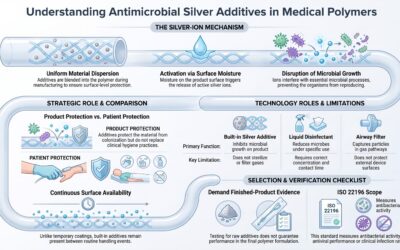
Incorporate a silver-based antimicrobial additive intended to inhibit bacterial, mould and mildew growth on the circuit material. The antimicrobial feature protects the product surface from microbial colonization; it does not make the circuit sterile or replace routine practices. BOMImed specifies that a properly rated high-efficiency airway filter is still required.[8]
Antimicrobial product protection is a supplemental control, not a complete infection-control system.
Pulmonary Function Filters
Create a barrier between the patient and shared spirometry equipment. BOMImed’s available filters are hydrophobic, latex-free and designed to combine microbial filtration with low breathing resistance.[9]
FlowMIR
Uses an individually sealed, pre-calibrated disposable turbine and mouthpiece. The component is designated for single-patient use and does not require cleaning, sterilization or a separate antibacterial filter when used as directed.[10] This design replaces reprocessing of the measuring component with controlled disposal and replacement.
Single-Patient-Use Laryngoscopy Handles
Individually packaged and supplied clinically clean, intended to reduce cross-patient transfer.[11] “Clinically clean” should not be interpreted as “sterile” — confirm packaging status, sterility claims and intended use from the specific product labelling before the component is introduced into a procedure.
Browse by category: Filters, Breathing Circuits and Spirometry Systems.
Prevent Clean and Contaminated Equipment From Crossing Paths
A well-executed cleaning process can be undermined by poor transport or storage. Contaminated equipment should not move through clean supply areas, and sterile and soiled devices should not be transported together.[2]
A one-way equipment workflow
- RemoveTake used equipment out of the patient-care area.
- ContainPlace it in a designated closed container or contaminated-equipment zone.
- Disassemble and cleanFollow the manufacturer’s written instructions.
- Disinfect or sterilizeComplete the required process for the device classification.
- InspectCheck for soil, moisture, cracks, wear or missing components.
- IdentifyLabel or otherwise mark its reprocessed status.
- StoreKeep it clean and dry, protected from dust, moisture and splash exposure.
- Hand hygienePerform hand hygiene before handling the equipment for the next patient.
Storage detail that is easy to miss: Clean supplies should not be stored under sinks or beside plumbing, because leaks and splashes can contaminate packaging and equipment.[1]
Measure Whether the Process Works Under Real Conditions
Environmental cultures are not the only way to evaluate contamination control. Routine programs should primarily measure whether critical processes are performed correctly and consistently.
Useful indicators
- Hand-hygiene compliance at defined equipment-handling moments
- Percentage of reusable devices with current manufacturer instructions available
- Compliance with cleaning and disinfection between patients
- Correct disinfectant dilution and contact time
- Single-patient-use components discarded at the required point
- Frequency of clean-to-dirty workflow breaches
- Completion of circuit and filter changes according to product instructions
- Percentage of equipment passing visual inspection after cleaning
- Staff competency assessments for device disassembly and reprocessing
- Documentation of damaged or difficult-to-clean equipment removed from service
On monitoring tools: Fluorescent markers and adenosine triphosphate testing may help assess whether a surface was physically cleaned. They do not independently prove that a device is sterile or free of clinically important microorganisms. Select the monitoring method for the specific question the facility needs to answer.
Common Contamination-Control Assumptions That Create Risk
“Antimicrobial means sterile.”
Antimicrobial materials may inhibit microbial growth on a product. They do not establish sterility or eliminate the need for cleaning, filtration and hand hygiene.
“A visibly clean device is safe to reuse.”
Microorganisms and residual organic material may remain even when contamination is not visible.
“Gloves prevent equipment contamination.”
Contaminated gloves can transfer microorganisms between the patient, equipment and environment.
“A higher filter-efficiency number is always better.”
Filtration performance must be balanced with resistance, dead space, humidification and patient-specific ventilation requirements.
“Disposable products require no infection-control process.”
Staff still need clean hands, appropriate storage, intact packaging and correct disposal procedures.
“All parts of a medical system need the same reprocessing.”
Patient-contact components, external controls and internal pathways can require different processing levels.
Reducing Contamination Starts With Equipment Design
The most dependable contamination-control process is one that remains practical during high patient volumes, urgent procedures and staffing changes. Equipment should be easy to identify, assemble, clean, inspect and store correctly. Components that require complex reprocessing should have validated instructions and realistic turnaround procedures.
Bringing infection prevention, respiratory therapy, anesthesia, biomedical engineering, environmental services and procurement teams into product selection allows contamination risks to be addressed before equipment reaches the patient-care area. That approach turns microbial control from a cleaning task into a property of the entire clinical workflow.
Related reading: Anti Microbial Technology Helps Reduce Microbial Growth on Medical Products and Antimicrobial Connectors for Medical Systems.
FAQ: Reducing Microbial Contamination
What is microbial contamination?
Microbial contamination is the presence of microorganisms on hands, equipment, materials or environmental surfaces. Contamination creates the potential for transmission but does not necessarily result in infection.
What is the difference between contamination and cross-contamination?
Contamination describes the presence of microorganisms. Cross-contamination occurs when those microorganisms are transferred from one person, device, material or surface to another.
How often should shared medical equipment be disinfected?
Shared non-critical equipment should generally be cleaned and disinfected between patients. Additional cleaning may be required when the equipment is visibly soiled, used under additional precautions or handled frequently.[1]
Does cleaning kill microorganisms?
Cleaning primarily removes soil, organic material and microorganisms through detergent, water and mechanical action. A separate disinfection or sterilization step may be required based on the device classification.
Are antimicrobial breathing circuits a replacement for filters?
No. An antimicrobial circuit may suppress microbial growth on the product material, but it does not automatically provide an airway-filtration barrier. Micro Protect Circuits specifically require a properly rated airway filter.[8]
Are single-patient-use medical devices sterile?
Not necessarily. “Single-patient use,” “single use,” “clinically clean” and “sterile” are different designations. The packaging and product labelling must be checked for the exact claim.
What specifications should be reviewed when selecting an airway filter?
Review filtration efficiency and test method, airflow resistance, internal volume, humidification performance, fluid resistance, connector configuration, patient size, intended duration and compatibility with the breathing system.
Sources
- Public Health Agency of Canada, “Routine Practices and Additional Precautions for Preventing the Transmission of Infection in Healthcare Settings,” 2017. canada.ca
- Public Health Ontario, “Best Practices for Cleaning, Disinfection and Sterilization in All Health Care Settings,” 2013. publichealthontario.ca
- Health Canada, “Information to Be Provided by Manufacturers for the Reprocessing and Sterilization of Reusable Medical Devices,” 2017. canada.ca
- Public Health Ontario, “Best Practices for Environmental Cleaning for Prevention and Control of Infections in All Health Care Settings,” revised 2025. publichealthontario.ca
- Public Health Agency of Canada, “Device and Surgical Procedure-Related Infections in Canadian Hospitals, 2019–2023,” 2025. canada.ca
- BOMImed, “Aquesure Filters,” 2026. bomimed.ca/product/aquesure-filters/
- BOMImed, “Aquesure Filter Humidifiers,” 2026. bomimed.ca/product/aquesure-filter-humidifiers/
- BOMImed, “Micro Protect Circuits,” 2026. bomimed.ca/product/micro-protect-circuits/
- BOMImed, “Pulmonary Function Filters,” 2026. bomimed.ca/product/pulmonary-function-filters/
- BOMImed, “FlowMIR,” 2026. bomimed.ca/product/flowmir/
- BOMImed, “Fiber Optic Laryngoscopy Handles, Single Patient Use,” 2026. bomimed.ca/product/fiber-optic-handles-single-patient-use/