









Infection Control
Anti Microbial Technology Helps Reduce Microbial Growth on Medical Products
Anti microbial technology adds a passive layer of surface protection to medical devices and components — reducing microbial colonization at high-touch, moisture-prone points in clinical workflows. Understanding what it does, what it does not do, and where it adds the most value is essential for sound purchasing and infection control decisions.
In This Article
- What Is Anti Microbial Technology?
- A Layered Safety Strategy
- Silver-Based Antimicrobial Additives
- Breathing Circuits as a Use Case
- BOMImed Micro Protect Circuits
- Not the Same as Sterilization
- Key Benefits
- Risks and Limitations
- Device Selection Framework
- High-Contact and Moisture-Exposed Environments
- FAQ
What Is Anti Microbial Technology in Medical Products?
Anti microbial technology refers to materials, additives, coatings, or surface treatments designed to inhibit the growth, survival, or reproduction of microorganisms on a product surface. In healthcare settings, it is most relevant when applied to devices, components, and surfaces that are frequently handled, exposed to moisture, or used near vulnerable patients.
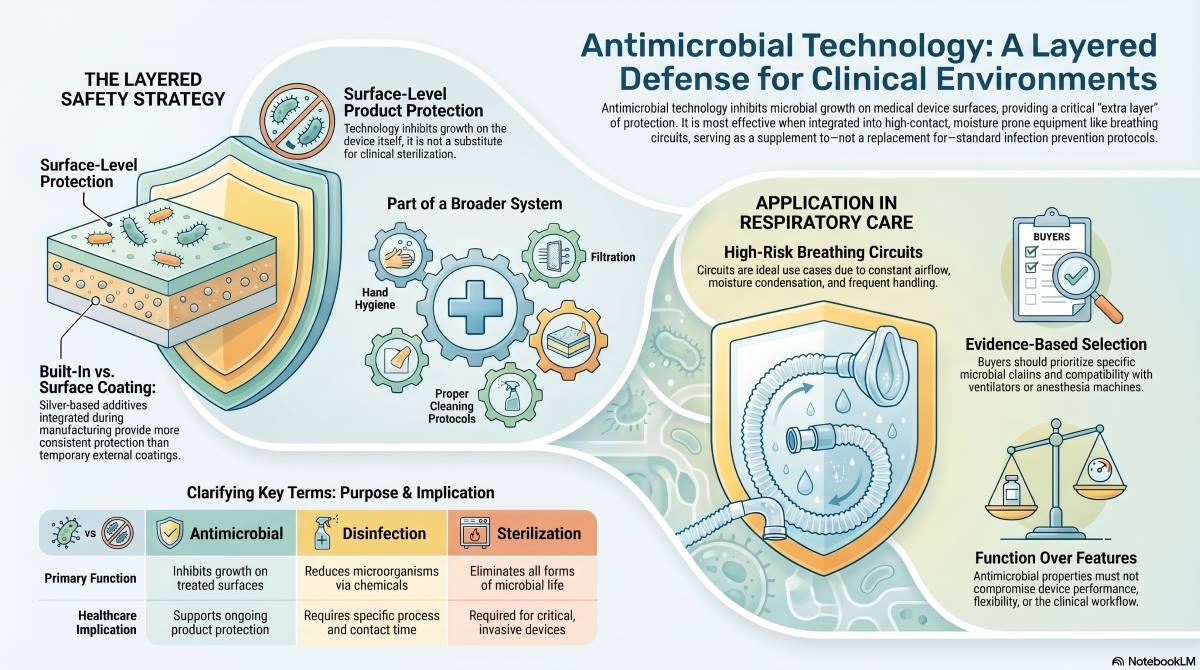
The purpose is not to replace cleaning, disinfection, sterilization, or infection prevention protocols. The purpose is to add another protective layer to the product environment. A medical device can still require appropriate handling, filtration, disposal, reprocessing, or cleaning even when antimicrobial properties are built into the material.
An important clinical distinction: antimicrobial protection typically refers to product protection — limiting microbial colonization on the device surface itself. Infection prevention is broader and includes hand hygiene, aseptic technique, environmental cleaning, airway filtration, single-use policies, equipment reprocessing, staff training, and patient risk assessment.
BOMImed’s product range — spanning anesthesia, respiratory, ventilator, infant care, patient monitoring, ultrasound, spirometry, and veterinary equipment — includes the Feather-Flex Micro Protect breathing circuits, which use BioCote® antimicrobial silver additive introduced during manufacturing.
Antimicrobial Protection Works Best as Part of a Layered Safety Strategy
Antimicrobial protection works best when healthcare teams treat the technology as one control within a larger risk management system. No single material feature can control every pathway of contamination.
Microorganisms may spread through direct contact, droplets, fluids, aerosols, contaminated hands, improperly handled accessories, or inadequately reprocessed equipment. A treated surface may reduce microbial growth on the product, but the surrounding clinical process still determines whether contamination risk is controlled.
A Layered Approach May Include
- ✓Proper product selection for the care environment
- ✓Single-patient-use or reusable design decisions aligned with institutional policy
- ✓Adherence to manufacturer instructions for use
- ✓Compatible airway filters where required by device guidelines
- ✓Cleaning and disinfection protocols maintained without modification
- ✓Staff training on correct handling and disposal procedures
- ✓Storage practices that protect clean supplies from environmental contamination
In anesthesia and respiratory care, the stakes are higher because breathing systems interact directly with the airway. Products used near the airway require careful attention to filtration, moisture management, condensate control, patient turnover protocols, and compatibility with the anesthesia machine or ventilator system. Antimicrobial technology can support cleanliness within that context — but clinical teams still need to understand precisely what the technology does and what it does not do.
Silver-Based Antimicrobial Additives Are Common Because They Interfere With Microbial Survival
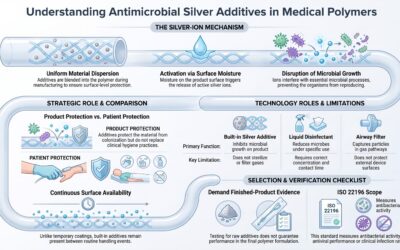
Silver-based antimicrobial additives are widely used because silver ions can disrupt microbial processes needed for growth and reproduction. When incorporated into a product during manufacturing, the additive becomes part of the material rather than a temporary surface treatment — an important distinction for long-term performance.
A coating may wear, separate, or degrade depending on use conditions. A built-in additive may provide more consistent surface-level antimicrobial performance across the treated material. Healthcare buyers should evaluate claims based on the specific device, not the general reputation of silver as an antimicrobial agent.
| Technology Type | How It Is Used | Practical Consideration |
|---|---|---|
| Silver additive | Built into plastic or polymer materials during manufacturing | Can provide ongoing product surface protection across the material lifecycle |
| Antimicrobial coating | Applied to an exterior surface after manufacturing | Durability depends on use conditions and cleaning exposure over time |
| Copper surface | Used on selected high-touch surfaces | More common in environmental surfaces than disposable breathing circuits |
| Hydrophilic / anti-adhesion surface | Designed to reduce microbial attachment at the surface level | Often more specialized and application-specific in design |
| Disposable sterile barrier design | Reduces contamination risk through single-use elimination of reuse | Not the same as antimicrobial technology — risk reduction mechanism differs |
The strongest product decisions come from matching the technology to the clinical risk. Antimicrobial features should be prioritized for devices and surfaces where microbial growth, handling frequency, moisture exposure, or patient vulnerability create a meaningful and specific concern.
Breathing Circuits Are a Relevant Use Case for Anti Microbial Technology
Breathing circuits are a strong use case for anti microbial technology because they operate in a clinical environment where airflow, moisture, patient contact, and equipment handling all converge. A breathing circuit helps deliver oxygen, ventilation support, or anesthetic gases while supporting the removal of exhaled carbon dioxide.
The circuit itself is not the only infection control factor — airway filters, humidification devices, connectors, masks, machine interfaces, and handling procedures all influence the risk profile. However, because breathing circuits can be exposed to condensation and repeated touch during setup or adjustment, built-in product protection adds genuine value when properly engineered.
Antimicrobial Breathing Circuit Design Should Support
- ✓Resistance to microbial colonization on the circuit surface across its intended use period
- ✓Compatibility with required airway filtration — the antimicrobial feature does not substitute for a correctly rated filter
- ✓Appropriate flexibility and drapability for the clinical setting and patient population
- ✓Correct sizing for adult, pediatric, or neonatal use cases
- ✓Safe integration with anesthesia machines or ventilator systems in use
- ✓Clear instructions for use and disposal from the manufacturer
The clinical value of antimicrobial breathing circuit technology is strongest when the protection does not compromise performance. A circuit still needs to deliver gases reliably, maintain expected flow characteristics, connect securely, and support the care team’s workflow without added complexity.
BOMImed’s Micro Protect Circuits Connect Antimicrobial Design to Clinical Workflow
BOMImed’s Feather-Flex Micro Protect breathing circuits directly connect antimicrobial technology to anesthesia and respiratory care workflows. The Micro Protect line uses BioCote® antimicrobial silver additive introduced during manufacturing, with the stated purpose of limiting microbial colonization on the breathing circuit surface.
That product positioning is well-suited to BOMImed’s broader clinical offering, which already serves environments where airway support, anesthesia delivery, ventilation, patient monitoring, and respiratory equipment decisions are closely connected. The antimicrobial feature is positioned as a complement to clinical controls — not a substitute for them.
BOMImed specifies that a properly rated airway filter is required with the Micro Protect circuit. This requirement reinforces the correct interpretation of antimicrobial protection as one layer within a broader infection control strategy — not a standalone safeguard.
For hospitals, surgical centers, and acute care settings, that balance matters. Antimicrobial technology is most credible when it is tied to a specific device function, a defined workflow, and clear usage requirements. BOMImed’s Micro Protect positioning meets that standard by connecting antimicrobial product protection with breathing circuit design, filtration requirements, and clinical equipment compatibility.
Antimicrobial Technology Is Not the Same as Sterilization or Disinfection
Antimicrobial technology reduces or inhibits microbial growth on a treated surface. Sterilization destroys all forms of microbial life through a validated process. Disinfection reduces pathogenic microorganisms on surfaces, but the level of disinfection depends on the chemical agent, exposure time, surface type, and cleaning protocol. Confusing these terms can create unsafe expectations in clinical practice.
| Term | Meaning | Healthcare Implication |
|---|---|---|
| Antimicrobial | Inhibits microbial growth on a treated surface | Supports product surface protection between cleaning events |
| Antibacterial | Targets bacteria specifically | May not address fungi, viruses, or other microorganisms |
| Disinfection | Reduces microorganisms on surfaces or equipment | Requires correct process, chemical, and contact time to be effective |
| Sterilization | Eliminates all microbial life through a validated process | Required for many critical-use devices before each patient use |
| Reprocessing | Cleans, disinfects, tests, or sterilizes reusable devices | Must follow validated manufacturer instructions without deviation |
An antimicrobial product is not automatically sterile during use. A sterile product can become contaminated after opening or handling. A disinfected surface does not retain antimicrobial properties after the disinfectant has dried. Antimicrobial technology should be evaluated as a product feature — not a universal infection control claim.
The Main Benefits Are Product Protection, Workflow Support, and Reduced Surface Colonization
The primary benefit of antimicrobial technology is better protection against microbial growth on the treated product surface. In practice, that benefit can support healthcare workflows where contamination control depends on both product design and staff adherence to protocols.
-
→
Reduced microbial colonization on treated surfaces between handling and cleaning events -
→
Better product cleanliness in the intervals between use cycles -
→
Additional protection in moisture-prone environments such as ventilator and anesthesia circuits -
→
Support for high-risk clinical areas where patient vulnerability and equipment exposure overlap -
→
Lower likelihood of microbial growth affecting product integrity over its intended use period -
→
Added confidence in product selection for acute care environments with elevated contamination risk
These advantages are strongest when the product is used correctly. Antimicrobial protection should enhance a clinically sound product — not compensate for weak design, unclear instructions, or poor workflow fit.
Risks and Limitations Should Be Understood Before Product Selection
Antimicrobial technology has limitations because real-world contamination is more complex than laboratory surface testing. A product may perform well against specific organisms under controlled conditions while facing substantially different conditions in clinical use.
Common Limitations to Evaluate
- Claims may apply only to the treated surface, not to connectors, filters, or accessories
- Performance may vary by organism type — not all antimicrobial products address all relevant pathogens
- Organic matter such as blood, secretions, or condensate can interfere with surface-level protection
- Incorrect cleaning products may affect treated materials or degrade surface properties
- Treated products may still require single-use disposal or formal reprocessing per manufacturer instructions
The Risk of Misleading Language
Broad claims such as “kills germs” or “prevents infection” can be misleading unless supported by the product’s actual intended use and regulatory positioning. Healthcare teams should look for precise, specific claims: what organisms were tested, what surface was treated, what reduction was measured, and under what use conditions results apply.
Antimicrobial technology must not create complacency. The presence of antimicrobial properties must never reduce adherence to hand hygiene, equipment cleaning, filter requirements, or manufacturer instructions for use.
Device Selection Should Start With Clinical Use, Not the Antimicrobial Claim
Device selection should begin with the care setting, patient population, equipment compatibility, and risk level. Antimicrobial technology becomes relevant after the core clinical requirements are clearly established — not as the primary selection driver.
| Selection Factor | Why It Matters |
|---|---|
| Clinical setting | Operating rooms, ICUs, and transport environments carry different risk profiles and equipment requirements |
| Patient population | Neonatal, pediatric, and adult circuits require different configurations, sizing, and compliance characteristics |
| Device compatibility | Circuits and accessories must be verified to fit the intended anesthesia machine or ventilator system |
| Filtration requirements | A correctly rated airway filter may be required for safe use alongside the breathing circuit |
| Single-use or reusable status | Disposal and reprocessing expectations affect workflow, cost, and compliance obligations |
| Evidence behind claims | Antimicrobial language should be specific, measurable, and tied to validated testing conditions |
| Supply reliability | Clinical teams need consistent, uninterrupted product availability to maintain safe workflows |
The strongest fit occurs when antimicrobial technology solves a practical problem without adding complexity. A treated product that requires unusual handling, unclear setup, or incompatible cleaning procedures may create more operational friction than benefit.
Antimicrobial Materials Are Most Useful in High-Contact and Moisture-Exposed Environments
Antimicrobial materials are most useful where surfaces are frequently touched, exposed to moisture, or positioned near vulnerable patients. These conditions create more opportunity for microbial survival, transfer, and growth — making passive surface protection more clinically meaningful.
Relevant clinical environments include operating rooms, intensive care units, emergency departments, respiratory therapy areas, endoscopy suites, outpatient procedure rooms, and veterinary surgical settings. In these areas, antimicrobial technology can support cleaner product conditions when paired with proper workflow controls.
The value is highest in products that combine several risk factors simultaneously. A dry, low-touch storage component carries a low risk profile and likely does not require antimicrobial material. A breathing circuit used in an acute care setting presents a different risk profile entirely — airflow, moisture, patient proximity, and repeated handling can all overlap within a single use cycle.
Healthcare teams should avoid treating antimicrobial technology as a default premium feature. The more direct the connection between the product surface, the clinical workflow, and a specific contamination concern — the stronger the case for antimicrobial design. Risk-based selection, not feature-based selection, leads to the best outcomes.
Frequently Asked Questions: Anti Microbial Technology in Medical Products
QWhat is anti microbial technology?
Anti microbial technology refers to materials, additives, or coatings designed to inhibit the growth or survival of microorganisms on a treated product surface. It is most relevant for medical devices and components that are frequently handled, moisture-exposed, or used near vulnerable patients.
QIs antimicrobial technology the same as antibacterial technology?
No. Antimicrobial technology may address bacteria, mold, mildew, or other microorganisms depending on the specific product claim. Antibacterial technology refers specifically to activity against bacteria and may not address fungi, viruses, or other relevant pathogens.
QDoes antimicrobial protection replace cleaning and disinfection?
No. Antimicrobial protection does not replace cleaning, disinfection, sterilization, filtration, hand hygiene, or manufacturer instructions for use. It functions as an additional passive layer within a broader infection control strategy — not as a substitute for any existing protocol.
QWhy is antimicrobial technology used in breathing circuits?
Antimicrobial technology is used in breathing circuits to help limit microbial colonization on the circuit surface in environments where airway equipment, moisture, and repeated handling are active concerns. It adds a layer of passive product protection without altering core circuit performance or workflow requirements.
QWhat should healthcare buyers look for in antimicrobial medical products?
Healthcare buyers should look for clear and specific performance claims, compatible product design for the intended clinical environment, proper manufacturer instructions for use, required accessories such as airway filters, and evidence that the antimicrobial feature genuinely supports the intended clinical workflow.
QCan antimicrobial products prevent healthcare-associated infections?
Antimicrobial products may support infection prevention strategies as one component within a layered approach, but individual products should not be described as preventing infections unless the specific product claim and supporting evidence justify that statement. Overstating antimicrobial capability creates unsafe clinical expectations.
QAre silver-based antimicrobial additives common in medical products?
Yes. Silver-based antimicrobial additives are widely used in medical products because silver ions can interfere with microbial growth and reproduction when incorporated into appropriate product materials. When introduced during manufacturing as a built-in additive rather than a surface coating, silver-based protection tends to be more durable across the product’s use lifecycle.
QWhat is BioCote® and how is it used in BOMImed products?
BioCote® is a silver ion-based antimicrobial additive incorporated into product materials during the manufacturing process. BOMImed uses BioCote® in its Feather-Flex Micro Protect breathing circuits to limit microbial colonization on the circuit surface. The additive becomes part of the circuit material rather than a surface coating, supporting consistent antimicrobial performance across the product’s intended use period.
BOMImed Micro Protect Breathing Circuits for Canadian Clinical Settings
BOMImed’s Feather-Flex Micro Protect circuits combine BioCote® silver ion antimicrobial protection with clinically proven breathing circuit design — for anesthesia, respiratory, and ventilator applications across medical and veterinary settings.