







Antimicrobial silver additives are compounds incorporated into materials such as medical polymers to inhibit microbial growth on treated product surfaces. Unlike a disinfectant applied during cleaning, a built-in additive becomes part of the manufactured material and can provide ongoing surface-level protection throughout the product’s intended life. Silver additives are available in several forms, including salts, metals, glass-based carriers and nanosilver, so their chemistry, release behaviour and suitability cannot be assumed to be identical.[1]
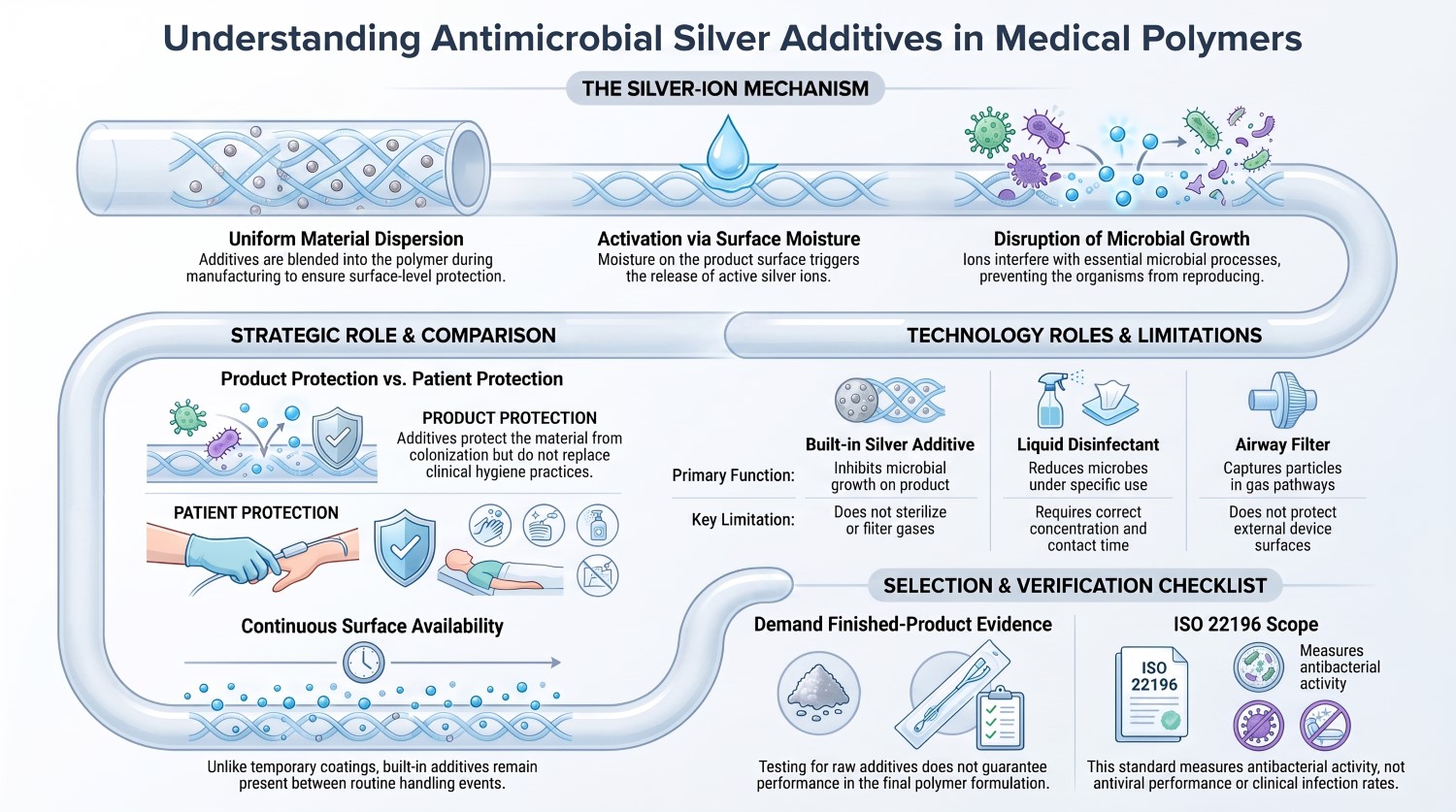
Antimicrobial silver additives work by making silver ions available at the surface of a treated material. In the presence of moisture, those ions interfere with functions microorganisms need to grow and reproduce.[1] The resulting activity protects the treated product surface; it does not sterilize a medical device, filter respiratory gases or replace established infection-prevention practices.
Direct Answer: A silver additive is blended into a polymer during manufacturing and releases silver ions at the treated surface, inhibiting the growth and reproduction of susceptible microorganisms. It protects the product material. It does not sterilize the device, filter respiratory gas, or replace filtration, hand hygiene, cleaning or labelled use requirements — and the presence of silver alone does not establish antimicrobial performance.
Silver additives are not a single technology
Silver salts
One of several carrier chemistries, each with its own release behaviour.
Metallic silver
Elemental silver incorporated into the host material.
Glass-based carriers
Silver held in a glass matrix that governs ion availability.
Nanosilver
Nano-sized silver, with material and release characteristics of its own.
Key takeaway: These forms are not equivalent. Chemistry, release behaviour and suitability differ, so evidence for one additive does not transfer to another.[1]
How Antimicrobial Silver Additives Work in Medical Polymers
An antimicrobial additive is blended into a polymer or another host material during manufacturing. The goal is to distribute the active ingredient throughout the material so that antimicrobial activity is available at the finished surface rather than applied only as a temporary exterior treatment.
The surface-contact process
- 1DispersionThe additive is distributed through the polymer during production.
- 2Ion availabilityMoisture at the product surface makes silver ions available.
- 3ContactSusceptible microorganisms encounter the ions at the treated surface.
- 4DisruptionThe ions disrupt essential microbial processes, including replication, creating conditions that inhibit growth and reproduction.
The distinction between silver and silver ions is important. The incorporated silver-containing additive acts as a reservoir, while released silver ions are responsible for the antimicrobial effect. Performance therefore depends on the formulation, carrier system, host polymer, additive dispersion, surface exposure, moisture and organism being tested.
This is why the presence of silver does not prove performance. A finished material must make the active ions available at an effective level without compromising the device’s physical properties or intended function.
Built-In Additives Are Not the Same as Coatings, Disinfectants or Filters
Several technologies can address different parts of a contamination-control strategy, but they are not interchangeable.
Where each technology acts, and where it stops
| Technology | Where it acts | Primary function | Key limitation |
|---|---|---|---|
| Built-in silver additive | At the treated material surface | Inhibits microbial growth on the product | Does not remove soil, sterilize the device or filter gases |
| Antimicrobial coating | On an applied exterior layer | Adds activity to a selected surface | Durability depends on coating adhesion, wear and chemical compatibility |
| Liquid disinfectant | On a cleaned, exposed surface | Reduces susceptible microorganisms under validated use conditions | Requires the correct concentration, coverage and contact time |
| Airway filter | In the respiratory gas pathway | Captures particles or microorganisms according to the filter’s rated performance | Does not protect every external surface or replace correct handling |
| Sterilization process | Across a validated device or load | Renders a product sterile to the validated process standard | Applies only when the product and process have been designed and validated for sterilization |
Continuous is not instant. A built-in additive is valuable because it remains present between routine handling events. That continuous availability should not be confused with instant decontamination — microbial reduction develops under defined conditions and may vary with moisture, temperature, contact time, organism and surface contamination.
Antibacterial Test Results Must Be Read in Context
ISO 22196:2011 is the current international method for measuring antibacterial activity on treated plastics and other non-porous product surfaces. The standard was reviewed and confirmed in 2026.[2] It provides a controlled way to compare a treated sample with an untreated control, but it does not demonstrate that a device prevents healthcare-associated infections in clinical use.
The scope of ISO 22196
| What the standard establishes | What it does not establish |
|---|---|
| Antibacterial activity on treated plastics and other non-porous surfaces | Antiviral performance |
| A controlled comparison between a treated sample and an untreated control | Sterilization or sterility of the finished device |
| Results under specified laboratory conditions | Biodegradability |
| A defined, repeatable test method | Secondary effects such as odour prevention or resistance to material deterioration |
Claims involving mould, mildew, viruses or other microorganisms require evidence appropriate to those organisms and the finished product.[2]
Questions to ask when reviewing an antimicrobial medical material
- Was the exact finished material tested, rather than only the raw additive?
- Which organisms were included?
- Which test method, contact time and environmental conditions were used?
- Was performance compared with an otherwise equivalent untreated control?
- Does the stated reduction apply to the full device or only to specified treated components?
- Was antimicrobial performance evaluated across the product’s intended life and use conditions?
- Are the results antibacterial, antifungal or antiviral, and are those categories clearly separated?
A percentage without this context is incomplete. A claim of “up to 99.9%” describes the highest result under specified test conditions. It does not mean that every organism is reduced by the same amount at every point in use.
Product Protection and Patient Protection Are Different Claims
The most defensible purpose of a built-in silver additive is to protect the treated material against microbial colonization. Patient protection is a broader clinical outcome that depends on far more than the material.
Two different claims, two different evidence requirements
Product protection
- Protects treated material against microbial colonization
- May help control microbe-related staining, odours or material degradation
- Keeps the product surface less supportive of microbial growth
- Demonstrable by finished-material testing under defined conditions
Patient protection
- Depends on the complete device and route of exposure
- Depends on staff handling, filtration, environmental cleaning and hand hygiene
- Depends on aseptic technique, patient susceptibility and adherence to instructions for use
- Cannot be established by a laboratory reduction on a treated plastic surface alone
This distinction is especially important for medical devices. Canada’s Medical Devices Regulations require devices to be safe, perform as intended, use compatible materials and minimize reasonably foreseeable hazards, including contamination or microbial residue. A product sold as sterile must also be manufactured and sterilized under appropriately controlled conditions using a validated method.[3]
An antimicrobial material claim is not a sterile claim.
Silver Additives Support a Layered Infection-Control Strategy
Antimicrobial materials work best as an engineering control within a larger system of routine practices. The Public Health Agency of Canada’s infection-prevention framework addresses multiple transmission routes and control measures rather than relying on a single surface feature.[4]
For a medical breathing circuit, that layered approach can include:
- Correct circuit selection for the patient, device and procedure
- A properly rated airway filter when required
- Hand hygiene before and after relevant patient or equipment contact
- Aseptic handling of connectors and patient interfaces
- Condensate and moisture management according to facility procedures
- Adherence to single-patient-use, replacement and disposal instructions
- Cleaning and disinfection of compatible reusable equipment
- Storage that protects clean supplies before use
Each control has a separate role. The additive addresses microbial growth on treated material. Filtration addresses the gas pathway. Handling and hygiene address transfer by hands and equipment. Product labelling defines approved use. None should be removed merely because an antimicrobial component is present.
For a fuller treatment of how these layers fit together, see How to Reduce Microbial Contamination in Healthcare and Infection Control in Medical Equipment Selection.
How BOMImed Uses a Silver Additive in Micro Protect Circuits
BOMImed incorporates a BioCote® antimicrobial silver additive during the manufacture of Micro Protect breathing circuits. The company states that released silver ions inhibit the growth and reproduction of bacteria, mould and mildew on the treated material, and identifies Escherichia coli and methicillin-resistant Staphylococcus aureus as relevant examples.[5]
BioCote reports that the technology in Micro Protect non-heated breathing circuits can inhibit microbial growth on product surfaces by up to 99.9%, depending on the test and microbial strain. The supplier also specifies that the technology is intended to protect product integrity and is not a replacement for cleaning protocols.[6]
Micro Protect Circuits
Available in dual-limb and coaxial configurations, including custom configurations. BOMImed specifies that a properly rated airway filter is required and recommends compatible Aquesure™ bacterial/viral or HEPA filtration options.[5]
That filter requirement reinforces the correct division of responsibilities: the silver additive acts on treated circuit material, while the filter performs a separate function in the respiratory gas pathway.
Important limitation: Antimicrobial incorporation does not authorize use beyond the circuit’s approved clinical-use period, cross-patient reuse, or changes to facility procedures. The device labelling, instructions for use and institutional policies remain controlling.
Related reading: BioCote® Protection in Medical Breathing Circuits.
What to Verify Before Selecting a Silver-Treated Medical Product
The strongest antimicrobial specification connects material science to the actual device and workflow. A purchasing or clinical evaluation should cover six areas.
- 1The intended claimDetermine whether the technology is intended to protect the product, support surface hygiene or deliver a defined clinical benefit. Broad language such as “kills germs” is less useful than an organism-specific, surface-specific claim.
- 2The finished-product evidenceEvidence for a raw additive does not automatically prove the performance of every polymer formulation. Colourants, plasticizers, wall thickness, surface texture and processing conditions can affect dispersion and ion availability. Request results for the finished material or a technically equivalent production sample.
- 3The microorganism and test methodAntibacterial, antifungal and antiviral activity are separate evidence categories. Confirm that the cited method matches the claim and that the organism is relevant to the intended setting.
- 4Performance over the intended lifeAsk whether activity has been demonstrated after relevant storage, flexing, wear or cleaning exposure. The expected life of the antimicrobial feature must not be used to extend the device beyond its labelled use period.
- 5Device function and material compatibilityAntimicrobial performance cannot come at the expense of gas delivery, connector security, flexibility, pressure characteristics, biocompatibility or any other essential performance requirement.
- 6Integration with clinical controlsInstructions should state what filtration, handling, disposal, cleaning or reprocessing requirements still apply. A credible antimicrobial product makes these limits explicit.
The practical value depends less on the word “silver” and more on the quality of the finished-product evidence. As material-level protection becomes more common, healthcare teams will need claims that identify the treated surface, tested organisms, applicable standard and boundaries of use with equal clarity.
Common Misreadings of Silver Additive Claims
“It contains silver, so it works.”
The additive is a reservoir; released ions produce the effect. Performance depends on formulation, carrier, host polymer, dispersion, surface exposure, moisture and organism.
“All silver additives are basically the same.”
Salts, metals, glass-based carriers and nanosilver differ in chemistry and release behaviour, and should not be treated as equivalent.[1]
“Antibacterial testing covers viruses and moulds.”
ISO 22196 assesses antibacterial activity only. Antiviral and antifungal claims require evidence appropriate to those organisms.[2]
“99.9% means 99.9% everywhere, always.”
It describes the highest result under specified test conditions, not a uniform reduction across every organism at every point in use.
“Built-in protection means instant decontamination.”
Reduction develops under defined conditions and varies with moisture, temperature, contact time, organism and surface contamination.
“An antimicrobial device is a sterile device.”
Sterility requires a separately validated manufacturing and sterilization process under controlled conditions.[3]
FAQ: Antimicrobial Silver Additives
What are antimicrobial silver additives?
Antimicrobial silver additives are silver-containing formulations incorporated into materials to release silver ions and inhibit microbial growth on treated product surfaces.
Are all antimicrobial silver additives made with nanoparticles?
No. Silver additives may use metals, salts, glass-based carriers or nano-sized silver. These forms have different material and release characteristics and should not be treated as equivalent.[1]
Do silver additives make a medical device sterile?
No. Antimicrobial activity inhibits susceptible microorganisms on a treated surface. Sterility requires a separately validated manufacturing and sterilization process.[3]
Can an antimicrobial breathing circuit be used without an airway filter?
Only if the device manufacturer’s instructions explicitly allow it. Surface antimicrobial protection and airway filtration perform different functions; a required filter remains required.
Does ISO 22196 prove that a product prevents infections?
No. ISO 22196 measures antibacterial activity on treated plastics and other non-porous surfaces under laboratory conditions. It does not measure clinical infection outcomes.[2]
How long does a built-in silver additive remain active?
The additive is designed to remain part of the material for the product’s expected functional life. That does not change the device’s labelled replacement, disposal or single-patient-use requirements.
Are antibacterial and antiviral claims interchangeable?
No. Evidence against bacteria does not establish activity against viruses, moulds, yeasts or bacterial spores. Each claim requires an appropriate test method and product-specific evidence.
Sources
- BioCote®, “What Are Antimicrobial Silver Additives?,” 2025. biocote.com
- International Organization for Standardization, “ISO 22196:2011 — Measurement of Antibacterial Activity on Plastics and Other Non-Porous Surfaces,” 2011, reviewed and confirmed 2026. iso.org
- Justice Laws Website, Government of Canada, “Medical Devices Regulations, SOR/98-282,” accessed 2026. laws-lois.justice.gc.ca
- Public Health Agency of Canada, “Routine Practices and Additional Precautions for Preventing the Transmission of Infection in Healthcare Settings,” 2017. canada.ca
- BOMImed, “Micro Protect Circuits,” accessed 2026. bomimed.ca/product/micro-protect-circuits/
- BioCote®, “BOMImed Antimicrobial Breathing Circuits,” 2025. biocote.com