








In This Article
- Spirometry Measures Airflow and Forced Lung Volume
- PFT Is a Broader Category of Lung Function Testing
- Spirometry vs PFT: Side-by-Side Comparison
- When Spirometry Is the Right Test
- When a Broader PFT Is More Appropriate
- Reliable Results Depend on Testing Quality
- Choosing Between Spirometry Equipment and Full PFT Capability
- BOMImed Spirometry Systems
- Common Misunderstandings
- FAQ
- Sources
Spirometry vs PFT is not a comparison between two unrelated tests. Spirometry is one type of pulmonary function test, while PFT is the broader category of lung function testing. A pulmonary function test may include spirometry alone, or it may include additional testing such as lung volumes, diffusion capacity and bronchodilator response testing.[1]
That distinction matters because the right test depends on the question being asked. Spirometry is often the first-line test for measuring airflow limitation. A full PFT gives a broader view of how the lungs move air, hold air and transfer gases.
Spirometry Measures Airflow and Forced Lung Volume
Spirometry is a focused breathing test that measures airflow and volume during a forced breathing maneuver. The most familiar values are FEV1 (the amount of air exhaled in the first second), FVC (the total amount of air forcefully exhaled after a full inhalation), and the FEV1/FVC ratio, which is commonly used to help identify airflow obstruction.[2]
During testing, the patient takes a full breath in and exhales as hard and fast as possible into a spirometer. The test is repeated so the operator can confirm that the results are acceptable and reproducible. Current ATS/ERS spirometry standards emphasize obtaining at least three acceptable FEV1 and FVC measurements within a testing set.[3]
Spirometry is commonly used to help evaluate:
- Possible asthma or COPD
- Airflow obstruction
- Bronchodilator response
- Baseline lung function
- Lung function changes over time
- Workplace or environmental respiratory risk
PFT Is a Broader Category of Lung Function Testing
A PFT is not always one single test. It is a family of breathing tests used to assess different parts of pulmonary function, including airflow, lung volume and gas transfer. The most common PFTs include spirometry, diffusion studies and body plethysmography.[1]
| Test | What It Measures | Why It Is Used |
|---|---|---|
| Spirometry | Airflow and forced exhaled volume | Helps identify obstructive patterns and monitor lung function |
| Bronchodilator testing | Spirometry before and after inhaled medication | Helps assess reversibility of airflow limitation |
| Lung volume testing | Total lung capacity, residual volume and related measurements | Helps confirm restriction or detect air trapping |
| DLCO testing | Gas transfer from the lungs into the blood | Helps evaluate impaired gas exchange |
| Body plethysmography | Lung volumes measured in an enclosed chamber | Helps assess trapped air and total lung capacity |
This is why “PFT” can be confusing. In some clinical settings, a referral for PFT may mean basic spirometry. In others, it may mean a full pulmonary function lab evaluation.
Spirometry vs PFT: Side-by-Side Comparison
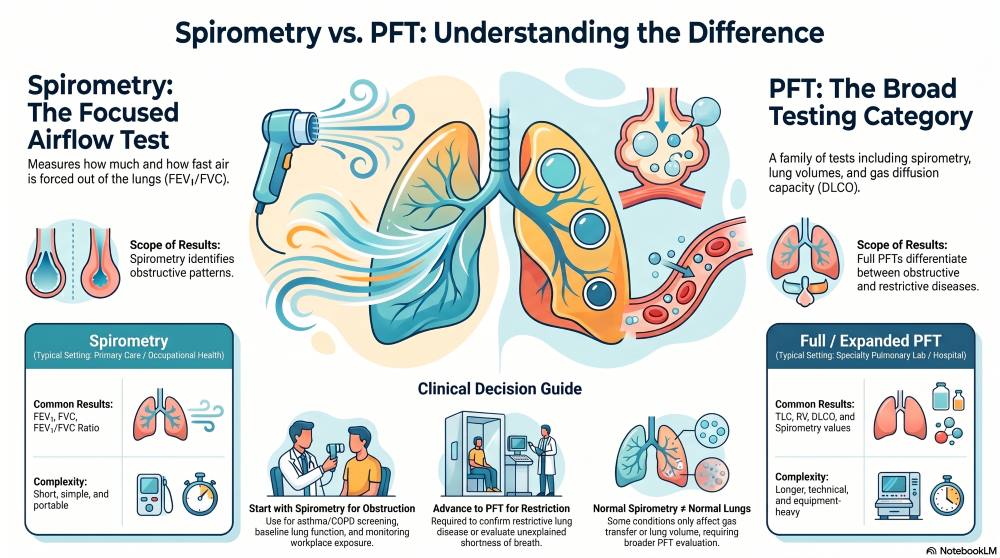
The simplest way to understand spirometry vs PFT is to treat spirometry as the focused airflow test and PFT as the broader testing category.
| Comparison Point | Spirometry | Full or Expanded PFT |
|---|---|---|
| Scope | Narrower — focused on airflow | Broader — multiple physiologic dimensions |
| Main purpose | Measures airflow and forced volume | Measures airflow, lung volumes and gas transfer |
| Common results | FEV1, FVC, FEV1/FVC, flow-volume loop | Spirometry values plus TLC, RV, DLCO and more |
| Typical setting | Primary care, occupational health, outpatient | Pulmonary function lab, hospital, specialty clinic |
| Useful for | Screening, monitoring, identifying obstruction | Differentiating obstructive, restrictive and gas exchange problems |
| Equipment needs | Spirometer, mouthpiece, filters, calibration tools | Additional systems for volumes, diffusion or advanced diagnostics |
| Complexity | Usually shorter and simpler | Usually longer and more technical |
When Spirometry Is the Right Test
Spirometry is often appropriate when the main concern is airflow obstruction or lung function monitoring. It is widely used because it is accessible, noninvasive and practical across many clinical environments.
Spirometry may be used when a patient has chronic cough, wheezing, shortness of breath or exercise limitation. It is also useful for monitoring asthma, evaluating possible COPD, assessing occupational exposure risk and documenting baseline respiratory function.
For COPD specifically, some clinical guidance recommends confirming a symptom-based diagnosis with post-bronchodilator spirometry showing an FEV1/FVC ratio below 0.7.[4]
When a Broader PFT Is More Appropriate
A broader PFT is more appropriate when spirometry results do not fully explain the patient’s symptoms, when restriction needs confirmation or when gas exchange is part of the clinical question.
A low FVC on spirometry may suggest restriction, but it does not automatically prove restrictive lung disease. Restriction is confirmed by measuring total lung capacity, which requires lung volume testing.
A clinician may consider a fuller PFT when evaluating:
- Suspected interstitial lung disease
- Unexplained shortness of breath
- Possible restrictive lung disease
- Preoperative pulmonary risk
- Neuromuscular respiratory involvement
- Complex occupational or environmental exposure
- Symptoms that do not match basic spirometry findings
Reliable Results Depend on Testing Quality
Spirometry and PFT results depend on proper patient effort, correct technique, accurate demographic inputs, device performance and qualified interpretation. A poor spirometry maneuver can produce misleading values if the patient does not inhale fully, starts exhaling too slowly, coughs early or stops too soon.
The 2022 ERS/ATS interpretive framework emphasizes using reference equations and limits of normal to determine whether measured values fall inside or outside the expected range for a healthy population.[5]
Quality spirometry depends on:
- Operator training and thorough patient coaching
- Repeatable, acceptable maneuvers confirmed across multiple efforts
- Review of both volume-time and flow-volume curves
- Correct patient demographic information for predicted value accuracy
- Infection control and routine device verification
- Calibration accuracy — the ATS/ERS standard specifies a 3-L calibration syringe must have accuracy of ±0.015 L or ±0.5% of full scale[3]
Choosing Between Spirometry Equipment and Full PFT Capability
A clinic does not always need a full pulmonary function lab. Many primary care, occupational health and specialty practices benefit from high-quality spirometry because the clinical need is focused on airflow measurement and monitoring.
| Decision Factor | Spirometry System May Be Enough | Expanded PFT Capability May Be Needed |
|---|---|---|
| Clinical question | Airflow obstruction or monitoring is the main concern | Restriction, gas exchange or complex physiology must be evaluated |
| Testing volume | Periodic or distributed across clinic settings | Supports a dedicated pulmonary lab |
| Staffing | Operators need a practical, efficient workflow | Specialized respiratory technicians are available |
| Space | Exam-room or mobile testing is preferred | Dedicated testing space is available |
| Reporting | Basic spirometry reports and EHR connectivity are sufficient | Multi-test reporting and advanced interpretation are required |
| Budget | Cost control and accessibility are priorities | Comprehensive diagnostics justify larger investment |
BOMImed Spirometry Systems for Clinical and Home Use
BOMImed offers a range of spirometry products for physician, hospital and home use, including handheld, PC-based, tablet-connected and desktop spirometry options.[6] This allows healthcare providers to choose a spirometry system that fits their testing environment rather than forcing every clinic into the same workflow.
Minispir™ Spirometer
A handheld, PC-based spirometer with EHR connectivity, real-time flow/volume and volume/time curves, selectable parameters and an embedded temperature sensor for BTPS conversion. Best suited for clinical environments that need a reliable PC-based device.[7]
Spirobank II™ BASIC
Designed for family doctors, occupational medicine, sports medicine and general practice. Features EHR/EMR connectivity, on-screen results and curves preview, and a long-life rechargeable battery. Strong option for clinics that need portability and stand-alone use.[8]
Spirobank II™ SMART
Supports stand-alone, tablet-based and PC-based use, with an oximetry option, mobile app support, incentive animations and the ability to share test results through PDF or HL7 standards. Well suited for more connected, multi-provider workflows.[9]
Spirolab™
Includes a 7-inch LCD colour touch screen, built-in thermal printer, PC connectivity through USB and Bluetooth, predicted sets and values, pediatric incentive support and large internal storage. A complete desktop-style spirometry option for facilities that need a comprehensive clinical workflow.[10]
Common Misunderstandings About Spirometry vs PFT
Spirometry is one pulmonary function test. PFT can refer to spirometry alone or a broader group of lung function tests.
Some conditions affect lung volumes, gas transfer or exercise physiology more than basic airflow values.
A low FVC can suggest a restrictive pattern, but total lung capacity is generally needed to confirm restriction.
Spirometry quality depends on patient coaching, repeatable maneuvers, curve review and quality control.
Expanded PFT testing is valuable when clinically indicated, but spirometry is often the more efficient first-line test when the question is airflow-based.
FAQ: Spirometry vs PFT
Is spirometry the same as a PFT?
Which is better, spirometry or a full PFT?
Can spirometry diagnose COPD?
Can spirometry detect restrictive lung disease?
What equipment does a clinic need for spirometry?
Why do spirometry results vary between tests?
Sources
- American Thoracic Society, “Pulmonary Function Tests,” 2026. site.thoracic.org
- American Thoracic Society, “What is spirometry?” Pulmonary Function Tests patient resource, 2026. site.thoracic.org
- Graham BL, Steenbruggen I, Miller MR, et al., “Standardization of Spirometry 2019 Update. An Official ATS and ERS Technical Statement,” 2019. pmc.ncbi.nlm.nih.gov
- Province of British Columbia, “Chronic Obstructive Pulmonary Disease (COPD): Diagnosis and Management,” updated 2025. gov.bc.ca
- Stanojevic S, Kaminsky DA, Miller MR, et al., “ERS/ATS Technical Standard on Interpretive Strategies for Routine Lung Function Tests,” 2022. publications.ersnet.org
- BOMImed, “Spirometry Systems,” 2026. bomimed.ca/product-category/spirometry-systems/
- BOMImed, “Minispir™ Spirometer,” 2026. bomimed.ca/product/minispir-handheld-spirometer/
- BOMImed, “Spirobank II™ BASIC,” 2026. bomimed.ca/product/spirobank-ii-basic-handheld-spirometer/
- BOMImed, “Spirobank II™ SMART,” 2026. bomimed.ca/product/spirobank-ii-smart-spirometer/
- BOMImed, “Spirolab™,” 2026. bomimed.ca/product/spirolab-spirometer-with-oximetry/