








A veterinary infusion pump controls the rate and volume of fluids and medications delivered to animal patients. Choosing the right one is less about feature count and more about fit — matching patient size, treatment type, staff workflow, and the level of precision your cases demand. This guide breaks down infusion versus syringe pumps, the features that matter most, how to think about cost, and the questions to ask before you buy.
Key Takeaways
- ✓The right pump fits your patients, treatments, workflow, and precision needs — not the one with the longest feature list.
- ✓Infusion pumps deliver larger volumes from an IV bag; syringe pumps offer finer control at very low volumes. Many clinics need both.
- ✓Prioritize features that support control and safety: flow range, VTBI, occlusion and air-in-line alarms, KVO, battery backup, and compatible IV sets.
- ✓Evaluate cost by total ownership and clinical risk, not sticker price alone.
- ✓The best pump for routine surgery may not be the best pump for ICU — match the device to the care environment.
- ✓Accuracy depends on the full infusion setup and staff training, not the pump mechanism alone.
In This Article
- Match the Way Your Clinic Delivers Care
- Infusion Pumps vs. Syringe Pumps
- Key Features to Compare
- Cost: Evaluate by Risk, Not Price
- Surgery vs. Critical Care Needs
- How Staff Workflow Shapes the Decision
- Accuracy Depends on the Full Setup
- When a Syringe Pump Is the Better Choice
- BOMImed Veterinary Pump Options
- Questions to Ask Before Buying
- FAQ
Veterinary Infusion Pumps Should Match the Way Your Clinic Delivers Care
A veterinary infusion pump is a medical device that controls the rate and volume of IV fluids, medications, blood products or nutrition delivered to an animal patient. For clinics, the right pump is not simply the one with the most features. It is the pump that fits patient size, treatment type, staff workflow and the level of precision required.
Veterinary infusion pumps are commonly used in surgery, anesthesia, hospitalization, emergency care and critical care. They help replace manual drip-rate management with programmed delivery, alarm feedback and more consistent control over total infused volume.
Choosing the right system matters because veterinary patients vary widely. A stable large-breed dog, a dehydrated cat, a neonate, an exotic patient and a critical care case do not have the same fluid tolerance. A clinic that performs routine procedures may need dependable volumetric fluid delivery, while a hospital managing CRIs, anesthesia support or fragile patients may need both infusion pumps and syringe pumps.
An important framing: the best pump is the one that fits the patient and the workflow. Feature count is secondary to patient size, treatment type, staff workflow, and the precision each case requires.
Infusion Pumps and Syringe Pumps Solve Different Problems
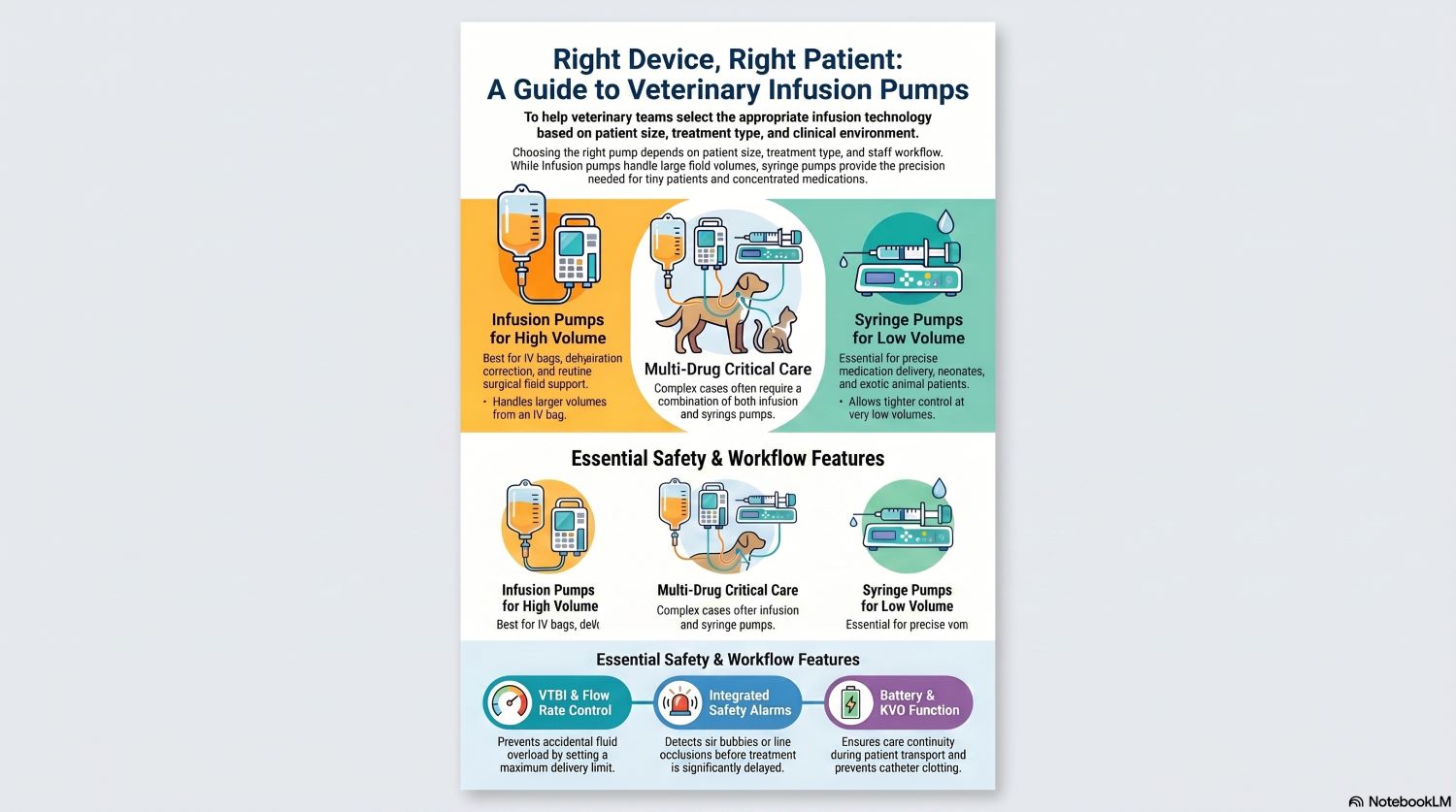
Infusion pumps and syringe pumps both deliver fluids in a controlled manner, but they are not interchangeable in every situation. The practical difference is the source container, flow range and level of low-volume precision.
A veterinary infusion pump usually delivers fluid from an IV bag through an administration set. It is commonly used for maintenance fluids, dehydration correction, anesthetic fluid support and longer-volume infusions.
A veterinary syringe pump delivers fluid or medication from a syringe. It is often used when the clinic needs very small volumes, fine dosing control or continuous medication delivery.
| Clinical Need | Better Fit | Reason |
|---|---|---|
| Routine IV fluids during surgery | Infusion pump | Handles larger fluid volumes from an IV bag |
| Hospitalized patient maintenance fluids | Infusion pump | Supports steady delivery over several hours |
| Tiny patients, neonates or exotics | Syringe pump | Allows tighter control at very low volumes |
| Continuous rate infusions | Syringe pump | Supports precise medication administration |
| Emergency fluid support | Infusion pump | Allows controlled volume delivery during stabilization |
| Multi-drug critical care support | Combination setup | May require both fluid and medication pumps |
Many clinics benefit from having both types available. An anesthetized patient may receive crystalloids from a volumetric infusion pump while a separate syringe pump delivers an analgesic CRI. The decision should reflect the therapy, not only the device category.
Key Features to Compare Before Buying a Veterinary Infusion Pump
The most important pump features are the ones that improve control, reduce workflow errors and help staff respond quickly when delivery is interrupted. A veterinary infusion pump should be easy to program, easy to monitor and practical to use throughout a normal clinical day.
Flow Rate Range
The pump should support the flow rates your clinic uses most often. Low-rate accuracy is especially important for cats, small dogs, neonates and fragile patients. Higher-rate capability may matter in emergency or larger-patient settings.
Volume-to-Be-Infused Control
Volume-to-be-infused, often called VTBI, allows staff to set a maximum amount of fluid to deliver. This feature is useful for limiting unintended overdelivery, especially when fluid tolerance is narrow or when the patient will be monitored over several hours.
Occlusion Alarms
Occlusion alarms alert the team when pressure builds in the line. A bent limb, clamped tubing, blocked catheter, kinked line or patient movement can interrupt delivery. A strong alarm system helps staff identify the problem before treatment is significantly delayed.
Air-in-Line Detection
Air-in-line detection helps identify air bubbles in the tubing. This is an important safety feature for IV administration, particularly when patients are moved, bags are changed or lines are reconnected.
KVO Function
KVO stands for keep vein open. This function allows a low flow rate after the programmed infusion is complete, helping reduce the chance of catheter clotting while the team reassesses the patient or prepares the next step.
Battery Backup
Battery operation is valuable when moving a patient between surgery, treatment, imaging and recovery areas. It also provides backup during temporary power interruptions.
Compatible IV Sets
Pump performance depends on compatible administration sets. Before purchasing, confirm whether the pump uses standard IV sets, manufacturer-specific sets or calibrated tubing. Inconsistent tubing can affect accuracy and increase nuisance alarms.
Clear Interface and Alarm Display
A pump should be usable by multiple team members across different shifts. Clear menus, visible settings and recognizable alarms reduce confusion, especially during urgent care.
Veterinary Infusion Pump Cost Should Be Evaluated by Risk, Not Price Alone
Veterinary infusion pump cost can vary widely because devices differ in design, accuracy, alarm systems, brand support, condition and intended clinical use. A low-cost pump may appear attractive, but the purchase price does not show the full cost of ownership.
Cost Factors to Weigh
- ✓New vs. refurbished equipment
- ✓Volumetric pump vs. syringe pump
- ✓Veterinary-specific design
- ✓Available alarm functions
- ✓Battery condition and replacement options
- ✓Tubing compatibility
- ✓Warranty or service support
- ✓Availability of accessories
- ✓Cleaning and maintenance needs
- ✓Training requirements
- ✓Supplier reliability
A very inexpensive device may be suitable for limited use only if the clinic can verify performance, compatibility and support. The risk is not just mechanical failure. Poor interface design, unclear alarms, inconsistent accuracy or hard-to-source tubing can create daily workflow problems.
A higher-quality pump can be more cost-effective when it reduces staff frustration, improves consistency, and remains serviceable over time. Evaluate the total role of the device in patient care, not only the upfront price.
The Best Pump for Surgery May Not Be the Best Pump for Critical Care
Surgical use often emphasizes reliable fluid delivery, fast setup and visibility from the anesthesia station. The team needs to confirm rate, volume remaining and alarm status while also monitoring anesthesia depth, blood pressure, ventilation and temperature.
Critical care use often requires more flexibility. Patients may need multiple infusions, frequent adjustments and closer attention to small changes in volume or medication dose. A single volumetric pump may not be enough when vasopressors, analgesics, insulin, nutrition or other controlled infusions are part of the plan.
Hospitalized patient care sits between these two environments. The pump must support repeatable nursing checks, clear documentation and stable delivery over time. Ease of use during shift changes is a major advantage.
A useful way to evaluate clinical fit is to match the device to the care environment:
| Care Environment | Pump Priority |
|---|---|
| Routine surgery | Simple setup, reliable flow control, visible alarms |
| Dental procedures | Compact footprint, predictable fluid support |
| Recovery area | Easy monitoring, VTBI control, battery backup |
| Hospital cages | Alarm audibility, line security, staff-friendly programming |
| Emergency care | Rapid setup, portability, flexible flow rates |
| ICU | Multi-pump scalability, syringe pump compatibility, precise control |
This approach prevents overbuying for routine needs or underbuying for complex care.
Staff Workflow Should Influence the Buying Decision
A veterinary infusion pump must fit the clinic’s workflow because the device will be used under real clinical pressure. The best pump on paper may not be the best pump for a team that needs fast setup, clear alarms and simple training.
Workflow Questions to Ask
- ✓Can a new team member learn the interface quickly?
- ✓Are the most common settings easy to access?
- ✓Can staff see the rate and volume from a normal working distance?
- ✓Are alarms specific enough to guide troubleshooting?
- ✓Is tubing loading intuitive?
- ✓Can the pump be cleaned quickly between patients?
- ✓Does the pump move easily with the patient?
- ✓Will the pump fit cages, IV poles, treatment tables or anesthesia areas?
- ✓Is documentation simple during rounds and shift handoffs?
A pump that supports clear routines is safer than one that depends on only one or two experienced staff members. Standardized setup, labeling and handoff procedures make the equipment more valuable.
Accuracy Depends on the Full Infusion Setup
Pump accuracy is affected by more than the pump mechanism. The full delivery system includes tubing, fluid source, catheter, patient position, line loading, programmed settings and ongoing monitoring.
Common Causes of Delivery Problems
- Incorrect tubing loaded into the pump
- IV line not fully primed
- Door or clamp not properly closed
- Kinked extension line
- Catheter occlusion
- Patient lying on the line
- Empty or nearly empty IV bag
- Incorrect units entered during programming
- Pump rate not adjusted after patient status changes
- Alarm silenced without resolving the cause
These issues make staff training essential. Veterinary teams should know how to load tubing, prime the line, set the rate, enter total volume, identify alarms, inspect the catheter site and document changes. A reliable device still requires reliable process.
When a Syringe Pump Is the Better Choice
A syringe pump is usually the better choice when very small volumes or precise medication delivery are required. This is common in small patients, critical care, anesthesia and continuous rate infusion protocols.
- →
Analgesic CRIs - →
Anesthetic adjuncts - →
Neonatal or exotic patients - →
Very small-volume fluid delivery - →
Concentrated medication administration - →
Insulin or other closely controlled protocols - →
Situations where a bag-based infusion is too imprecise
Syringe size compatibility is important. The pump should accept the syringe sizes your clinic uses and support the flow range needed for your protocols. Staff should also be trained to confirm drug concentration, patient weight, dose units and total infusion time.
For many clinics, the right answer is not infusion pump or syringe pump. The right answer is a combination that allows the team to choose the safest delivery method for each patient.
BOMImed Veterinary Infusion Pump Options
BOMImed offers veterinary infusion pumps and syringe pump options for clinics that need controlled fluid and medication delivery in animal care settings. The veterinary infusion pump category includes Mindray systems such as the BeneFusion eVP Vet infusion pump, BeneFusion eSP Vet syringe pump, BeneFusion eDS Vet docking station and AniFM infusion and syringe pump models.
These options support different clinical needs. A veterinary infusion pump may be appropriate for controlled IV fluid delivery from a bag, while a syringe pump may be better suited for low-volume medication administration or continuous rate infusions. A docking station may help clinics that need a more organized multi-pump setup in surgery, treatment or critical care areas.
For Canadian veterinary clinics comparing equipment, BOMImed’s product category gives teams a focused place to review infusion-related options within a broader veterinary equipment lineup. Clinics can evaluate pump type, use case and workflow fit alongside other equipment categories such as veterinary patient monitors, anesthesia equipment and surgical systems.
The most practical approach is to match the equipment to the clinic’s real treatment patterns. A general practice may need reliable pump support for surgery and hospitalization, while an emergency or specialty facility may need a more scalable combination of infusion pumps, syringe pumps and docking capability.
Questions to Ask Before Choosing a Veterinary IV Pump
A structured review can prevent clinics from choosing a pump based only on price or product description. Before purchasing, the team should answer the questions that affect daily use.
Clinical Use
- ✓Will the pump be used mainly for surgery, hospitalization, emergency care or ICU?
- ✓Does the clinic need bag-based infusion, syringe delivery or both?
- ✓Are most patients dogs and cats, or does the clinic treat exotics, neonates or large animals?
Performance
- ✓What flow rates are needed?
- ✓Does the pump support accurate low-volume delivery?
- ✓Can the team set a volume-to-be-infused limit?
- ✓Are alarms appropriate for occlusion, air, completion and low battery?
Workflow
- ✓Is the pump easy to program during busy procedures?
- ✓Can staff troubleshoot alarms quickly?
- ✓Is the screen readable in the treatment area?
- ✓Can the device move with patients when needed?
Ownership
- ✓Are compatible IV sets easy to obtain?
- ✓Is service or support available?
- ✓Are replacement accessories accessible?
- ✓Does the pump fit the clinic’s cleaning and maintenance routines?
A good pump decision should make care more consistent, not more complicated.
Better Infusion Decisions Create More Consistent Care
Choosing a veterinary infusion pump is a clinical workflow decision as much as an equipment purchase. The right pump supports accurate delivery, clear alarms, practical staff routines and patient-specific care across surgery, recovery, hospitalization and critical treatment.
As veterinary clinics manage more precise fluid therapy and more complex medication protocols, infusion equipment should be selected for how well it supports real patients, real staff and real treatment environments.
Frequently Asked Questions: Veterinary Infusion Pumps
QWhat is a veterinary infusion pump used for?
A veterinary infusion pump is used to deliver IV fluids, medications, blood products or nutrition to animal patients at a controlled rate and volume.
QIs a veterinary infusion pump the same as an IV pump?
Yes, the terms are often used interchangeably. An IV pump or veterinary infusion pump controls intravenous fluid or medication delivery.
QWhat is the difference between an infusion pump and a syringe pump?
An infusion pump usually delivers fluid from an IV bag, while a syringe pump delivers smaller volumes from a syringe with finer control.
QHow much does a veterinary infusion pump cost?
Cost varies based on pump type, condition, features, brand, support and accessories. Clinics should compare total usability and serviceability, not only purchase price.
QWhat features matter most in a veterinary infusion pump?
Important features include flow control, VTBI settings, occlusion alarms, air-in-line detection, KVO function, battery backup and compatible IV sets.
QAre syringe pumps better for cats and small patients?
Syringe pumps can be better for very small patients or low-volume medications because they offer precise delivery from a syringe.
QCan infusion pumps prevent fluid overload?
Infusion pumps help control rate and total volume, which can reduce accidental overdelivery. Patient monitoring is still required to assess whether the fluid plan remains appropriate.
QDo veterinary clinics need both infusion pumps and syringe pumps?
Many clinics benefit from both. Infusion pumps are useful for IV fluids, while syringe pumps are useful for small-volume medications and CRIs.
BOMImed Veterinary Infusion & Syringe Pumps for Canadian Clinics
From routine surgery to ICU, BOMImed offers Mindray BeneFusion eVP Vet, eSP Vet, eDS Vet and AniFM infusion and syringe pump options — matched to patient size, treatment type and clinical workflow across veterinary care settings.