







Infection control in medical equipment means selecting and managing devices in ways that reduce the risk of pathogen transfer during patient care. That includes using appropriate filters, choosing single-patient-use components where clinically appropriate, following manufacturer reprocessing instructions for reusable devices, evaluating antimicrobial product protection carefully, and ensuring staff can clean, disinfect or replace items consistently.
Infection control is not limited to cleaning protocols. It also depends on how medical equipment is selected, handled, filtered, disinfected, reprocessed, replaced and documented across the care environment. In respiratory care, anesthesia, spirometry and veterinary medicine, device design can affect how easily teams reduce cross-contamination risk, protect equipment surfaces and maintain consistent hygiene practices between patients.
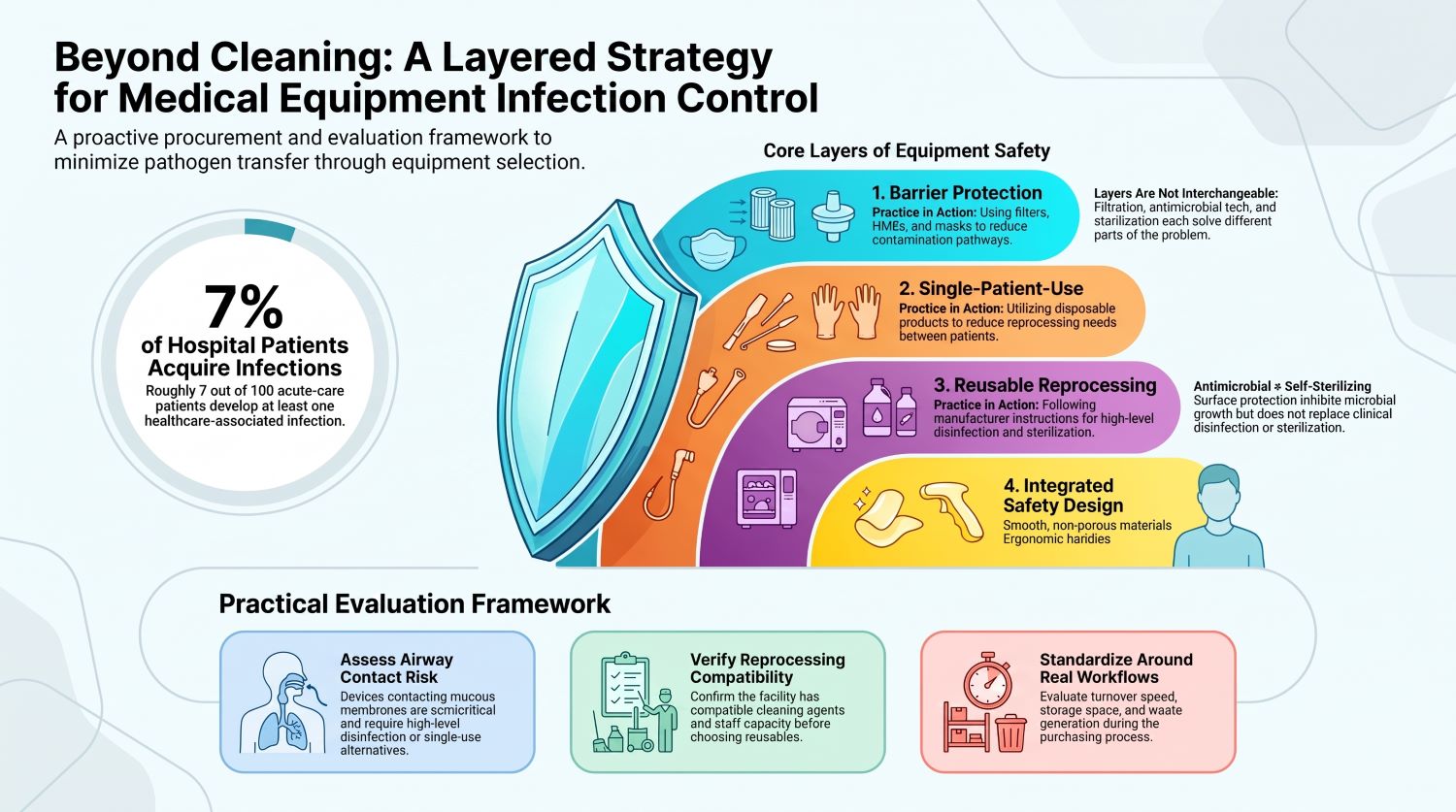
Direct Answer: A strong equipment strategy works across four layers — barrier protection through filters and circuit components, single-patient-use design, reusable-device reprocessing, and antimicrobial product protection. The critical point is that these are not interchangeable. Antimicrobial technology, filtration, cleaning, disinfection and sterilization each solve a different part of the infection-control problem.
Infection Control Starts With Equipment Decisions
Healthcare-associated infections remain a serious clinical concern. In acute-care hospitals, roughly 7 out of every 100 patients in high-income countries acquire at least one healthcare-associated infection during their stay, and the burden is higher in lower-resource settings.[1] Canadian infection prevention guidance also recognizes that healthcare-associated infections can spread from reusable patient-care equipment and environmental surfaces to people.[2]
For procurement teams, respiratory therapists, anesthesiologists, biomedical teams, infection prevention professionals and veterinary clinics, the practical question is not whether one product can “solve” infection control. The better question is whether each device supports the facility’s broader infection prevention and control process.
The Four Layers of Equipment Infection Control
What each infection-control layer means in practice
| Infection-control layer | What it means in practice |
|---|---|
| Barrier protection | Filters, HMEs, HMEFs, masks and circuit components that reduce contamination pathways |
| Single-patient-use design | Disposable or single-use products that reduce reprocessing needs between patients |
| Reusable-device reprocessing | Cleaning, disinfection and sterilization steps based on device risk and manufacturer instructions |
| Antimicrobial product protection | Materials engineered to inhibit microbial growth on product surfaces, without replacing cleaning or disinfection |
Key takeaway: Antimicrobial technology, filtration, cleaning, disinfection and sterilization are not interchangeable. Each solves a different part of the infection-control problem, and a gap in one cannot be covered by strengthening another.
Why Airway and Respiratory Equipment Carry Higher Infection-Control Demands
Respiratory and anesthesia products often contact the airway, exhaled moisture, secretions, mucous membranes or contaminated gas pathways. That makes workflow consistency especially important.
The CDC’s disinfection and sterilization recommendations classify anesthesia breathing circuits and respiratory therapy equipment as examples of semicritical patient-care equipment when they touch mucous membranes or nonintact skin, requiring at least high-level disinfection when reusable.[3] In real clinical workflows, that requirement creates a choice: use reusable devices with validated reprocessing steps, or choose single-patient-use components where appropriate to reduce the reprocessing burden.
This decision is not only clinical. It affects:
- Turnover speed between patients
- Storage and inventory management
- Staff training requirements
- Cleaning and sterilization capacity
- Waste generation
- Device compatibility
- Cost per use
- Risk exposure if reprocessing steps are missed
Timing matters: For airway-adjacent products, infection-control planning should happen before purchase, not after a device is already in circulation.
Antimicrobial Technology Is Product Protection, Not Sterilization
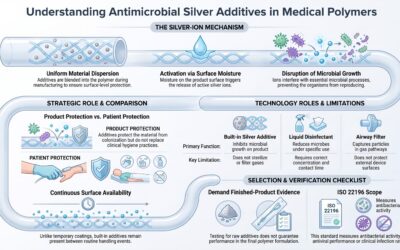
Antimicrobial technology is designed to inhibit microbial growth on a product surface. It should not be treated as a replacement for hand hygiene, cleaning, disinfection, sterilization, filtration, single-use policies or clinical infection-prevention protocols.
This distinction matters because antimicrobial language can be misunderstood. A medical device may include antimicrobial product protection to help reduce microbial colonization on the treated material, but that does not mean the product is sterile after use or that it prevents healthcare-associated infections by itself.
BOMImed’s Micro Protect circuits use a BioCote® antimicrobial silver additive introduced during the manufacturing process. The technology is described as limiting microbes on the surface of the breathing circuit and protecting the circuit from microbial colonization. The product line is listed with antimicrobial protection, reduced cross-contamination, dual-limb and coaxial options, custom configurations and a required high-efficiency airway filter.
The filter requirement is the important practical detail. Antimicrobial circuit material addresses the product surface. Airway filtration addresses the breathing pathway. A safe infection-control message should preserve that difference.
For a fuller treatment of what antimicrobial protection does and does not cover, see BioCote® Protection in Medical Breathing Circuits.
Single-Patient-Use Products Reduce Reprocessing Complexity
Single-patient-use products can support infection control by reducing the number of items that must be cleaned, disinfected or sterilized between patients. This can be especially valuable in busy anesthesia, respiratory, emergency, outpatient and veterinary settings where turnover time and staff workload affect compliance.
Single-use design does not eliminate the need for broader infection-control procedures. It changes the operational problem. Instead of validating reprocessing after each use, the facility must manage correct use, storage, inventory, disposal and staff compliance.
Where the work shifts
Single-patient-use shifts effort to
- Correct patient assignment and use
- Storage, inventory and consistent stock levels
- Disposal procedures and staff compliance
- Managing increased disposable supply needs and waste
Reusable shifts effort to
- Validated, device-specific reprocessing steps
- Cleaning and sterilization capacity and turnaround
- Staff training and consistent technique
- Inspection, documentation and post-reprocessing storage
Feather-Flex Anesthesia Circuits are positioned as single-patient-use breathing circuits designed to reduce cross-contamination risk while decreasing costs associated with sterilization, which makes them relevant for facilities evaluating disposable circuit options for standard anesthesia applications.
Single-patient-use airway products are also relevant for intubation workflows. BOMImed’s single-patient-use fiber optic laryngoscopy handles are packaged in individual peel pouches, supplied clinically clean, designed to reduce cross-contamination risk and positioned as eliminating cleaning and sterilization costs. Single-patient-use CPAP masks such as Air Escape Bi-Level CPAP Masks also support hygiene-sensitive respiratory workflows by assigning the patient interface to one patient rather than repeated shared use.
The tradeoff: Single-use products can increase disposable supply needs and medical waste. The decision should account for clinical risk, turnover volume, reprocessing capacity, storage space and sustainability goals.
Filtration Is a Critical Layer in Breathing Circuits and Respiratory Workflows
Filters help protect patients, staff, equipment and breathing systems by adding a barrier within the respiratory pathway. In anesthesia and ICU settings, bacterial/viral filters, HEPA options, heat moisture exchangers and filter humidifiers can support both infection-control and airway-conditioning needs.
Aquesure Filter Humidifiers include electrostatic or mechanical HEPA filtration, bacterial/viral filtration efficiency of 99.99999%, NIOSH N95, N99 or N100 filter options, humidification of the patient airway, and neonatal, pediatric and adult sizes. Aquesure Filters are also listed with 99.99999% bacterial/viral filtration efficiency, straight or angled configurations, optional gas sampling ports and adult or pediatric sizes.
Important limitation: Filtration selection should be based on the clinical setting, patient population, equipment compatibility, resistance, dead space, humidification needs and sampling requirements. A neonatal circuit, adult anesthesia circuit and ICU ventilator workflow will not have identical filtration needs.
Spirometry Infection Control Requires Special Attention
Spirometry creates a distinct infection-control challenge because testing involves forced exhalation through patient-contact components. Even when the device itself is reusable, mouthpieces, turbines, filters and patient interfaces need a clear infection-control plan.
BOMImed identifies single-patient FlowMIR® turbines, or reusable turbines with disposable filters, as options to minimize cross-contamination, along with nose clips and antibacterial filters sold in bulk. This is a practical example of layered infection control: the testing device, patient-contact component and filter strategy all matter.
Infection-control evaluation for spirometry equipment
- Whether the system supports disposable mouthpieces, turbines or filters
- Whether reusable parts have clear cleaning and disinfection instructions
- Whether the workflow reduces handling of contaminated components
- Whether staff can replace consumables without disrupting test volume
- Whether accessories are easy to stock in sufficient quantities
Key takeaway: Spirometry programs should avoid treating infection control as an accessory decision. It is part of the equipment model.
Reusable Devices Require Clear Reprocessing Instructions
Reusable medical devices can be safe and cost-effective when they are cleaned, disinfected or sterilized according to validated instructions. The infection-control risk increases when reprocessing steps are unclear, difficult to perform, poorly documented or inconsistent across staff.
Health Canada guidance for reusable medical devices states that manufacturers are expected to provide reprocessing information, including instructions related to effective cleaning, disinfection and sterilization.[4] For purchasers, that makes documentation part of the product evaluation process.
Confirm before adopting a reusable device
- 1Device-specific instructions existWritten cleaning and reprocessing instructions for that exact device.
- 2Facility compatibilityCompatible cleaning agents, disinfectants or sterilization methods are available.
- 3Workflow fitStaff can complete each step within normal workflow constraints.
- 4InspectabilityThe device can be checked for wear, cracks, residue or damage.
- 5Assigned responsibilityReprocessing ownership is clearly allocated, not assumed.
- 6Protected storageStorage keeps the device clean after reprocessing.
If those conditions are difficult to meet, single-patient-use alternatives may deserve closer review.
A Practical Infection-Control Evaluation Framework
A useful equipment review should compare clinical risk, workflow burden and device design together. The following framework can help teams evaluate respiratory, anesthesia, spirometry and veterinary products without relying on vague “hygienic” claims.
Infection-Control Evaluation Framework
| Evaluation question | Why it matters |
|---|---|
| Does the device contact the airway, mucous membranes or secretions? | Higher-contact devices usually require stricter infection-control planning. |
| Is the product single-patient-use, reusable or antimicrobial-protected? | Each category has different handling, disposal and reprocessing implications. |
| What filtration is required or recommended? | Filters may be essential for circuit, equipment and patient protection. |
| Are reprocessing instructions clear and facility-compatible? | A reusable device is only practical if the cleaning process can be followed reliably. |
| Does the design reduce handling complexity? | Fewer hard-to-clean areas, simpler assembly and clear replacement points can support compliance. |
| Can consumables be stocked consistently? | Infection-control plans fail when filters, masks, mouthpieces or circuit components are unavailable. |
| Does the claim match the function? | Antimicrobial protection, sterile supply, filtration and disinfection are different concepts. |
This framework is especially useful for purchasing committees because it connects clinical performance with operational reliability.
How BOMImed Supports Infection-Control Workflows
BOMImed supports infection-control planning through product categories that address airway, respiratory, anesthesia, spirometry and veterinary workflows. The value is not that one product category replaces infection-prevention protocols — it is that each product can support a specific layer of the process.
Micro Protect Circuits
Antimicrobial breathing circuits using a BioCote silver additive introduced during manufacturing, protecting the circuit surface from microbial colonization. Dual-limb and coaxial options with custom configurations. A high-efficiency airway filter is still required.
Aquesure Filters and Filter Humidifiers
Respiratory pathway protection with electrostatic or mechanical HEPA filtration and 99.99999% bacterial/viral filtration efficiency. Filter humidifiers add airway humidification and are available in neonatal, pediatric and adult sizes, with straight or angled configurations and optional gas sampling ports.
Feather-Flex Anesthesia Circuits
Single-patient-use breathing circuits for standard anesthesia applications, designed to reduce cross-contamination risk while decreasing costs associated with sterilization.
Single-Patient-Use Intubation and Mask Products
Fiber optic laryngoscopy handles in individual peel pouches, supplied clinically clean, positioned as eliminating cleaning and sterilization costs. Air Escape Bi-Level CPAP Masks assign the patient interface to one patient rather than repeated shared use.
FlowMIR and Spirometry Consumables
Single-patient pre-calibrated turbines, or reusable turbines paired with disposable pulmonary function filters, plus nose clips and antibacterial filters in bulk — supporting hygiene during repeated respiratory testing.
Browse by category: Breathing Circuits, Filters, Face Masks and Anesthesia Breathing Circuits.
For hospitals, surgical centers, outpatient clinics and veterinary practices, the strongest approach is to standardize products around real workflows: who handles the device, how often it is replaced, what touches the patient, what must be filtered, what must be reprocessed and what documentation staff need to follow.
Infection-Control Equipment Decisions Should Match the Care Setting
The right infection-control strategy depends on patient population, clinical acuity and workflow intensity.
Typical priorities by care setting
High-volume surgical center
Single-patient-use circuits and predictable supply flow.
Intensive care unit
Filtration, humidification, ventilator compatibility and circuit management.
Spirometry clinic
Disposable turbines, mouthpieces and filters.
Veterinary hospital
Anesthesia products that reduce cross-contamination across animal patients while supporting efficient turnover.
Better equipment selection does not replace clinical judgment. It makes good infection-control practice easier to perform consistently.
Misconceptions About Infection-Control Equipment
“Antimicrobial” does not mean “self-sterilizing.”
Antimicrobial technology may inhibit microbial growth on a treated product surface, but it does not make the product sterile after clinical use.
“Disposable” does not mean “no protocol needed.”
Single-patient-use products still require correct storage, handling, patient assignment and disposal.
“Reusable” does not mean “higher risk” by default.
Reusable devices can be appropriate when manufacturer instructions are clear, staff are trained and reprocessing capacity is reliable.
“Filter efficiency” is not the only selection factor.
Filtration efficiency matters, but resistance, dead space, size, humidification, sampling-port needs and patient population also affect suitability.
“Infection control” is not one department’s responsibility.
Procurement, clinical users, infection prevention, biomedical teams and materials management all influence whether equipment performs safely in daily use.
FAQ: Infection Control in Medical Equipment
What is infection control in medical equipment?
Infection control in medical equipment means selecting, using, cleaning, filtering, disinfecting, sterilizing or disposing of devices in ways that reduce the risk of pathogen transfer during patient care.
Are antimicrobial medical products a substitute for disinfection?
No. Antimicrobial product protection can inhibit microbial growth on treated surfaces, but it does not replace cleaning, disinfection, sterilization, filtration or facility infection-control protocols.
Why are breathing circuits important for infection control?
Breathing circuits are part of the airway pathway and may be exposed to moisture, secretions and respiratory gases. Their design, filtration requirements and reuse status affect how facilities manage cross-contamination risk.
When does single-patient-use equipment make sense?
Single-patient-use equipment may make sense when reprocessing is difficult, patient turnover is high, airway exposure is significant or facilities want to reduce cleaning and sterilization workload between patients.
What should clinics evaluate before choosing spirometry accessories?
Clinics should evaluate disposable mouthpieces, filters or turbines, reusable component cleaning instructions, accessory availability, patient flow and staff handling steps.
How do filters support infection-control workflows?
Filters add a barrier within respiratory and anesthesia systems. Selection should account for filtration efficiency, patient size, resistance, dead space, humidification and compatibility with the circuit or device.
Can reusable devices be used safely?
Yes. Reusable devices can be used safely when they have clear manufacturer reprocessing instructions and the facility can reliably clean, disinfect, sterilize, inspect and store them as required.
Sources
- World Health Organization, “WHO Launches First Ever Global Report on Infection Prevention and Control,” 2022. who.int
- Public Health Agency of Canada, “Healthcare Infection Prevention and Control Guidelines,” 2026. canada.ca
- Centers for Disease Control and Prevention, “Recommendations for Disinfection and Sterilization in Healthcare Facilities,” 2023. cdc.gov
- Health Canada, “Guidance Document: Information to Be Provided by Manufacturers for the Reprocessing and Sterilization of Reusable Medical Devices,” 2017. canada.ca