







Veterinary diagnostic equipment allows animal health professionals to investigate symptoms, assess organ function, identify disease and monitor changes in a patient’s condition. For Canadian veterinary clinics, choosing the right equipment requires more than comparing specifications. Buyers must also consider clinical demand, staff competency, workflow, service coverage and the regulatory requirements that apply in their province or territory.
The best veterinary diagnostic equipment is the equipment a clinical team can use confidently, maintain properly and integrate into everyday case management. A successful purchase should answer a recurring clinical question, produce dependable information quickly and remain supportable throughout its expected service life.
What Is Included in Veterinary Diagnostic Equipment?
Veterinary diagnostic equipment includes instruments used to obtain images, analyze biological samples or measure physiologic information that contributes to a diagnosis. The category commonly covers:
- Veterinary ultrasound systems
- Digital radiography equipment
- Hematology and clinical chemistry analyzers
- Urinalysis equipment
- Microscopes and cytology tools
- Endoscopy systems
- Electrocardiography equipment
- Blood pressure and vital signs devices
- Multiparameter patient monitors
- Infectious disease testing systems
These technologies do not serve the same purpose. Imaging equipment reveals anatomical structures, laboratory analyzers measure components of biological samples and patient monitors track physiologic parameters over time.
A monitor displaying electrocardiography, blood pressure, oxygen saturation, temperature and carbon dioxide data can support clinical assessment, anesthesia and critical care. However, monitoring data must still be interpreted alongside the physical examination, medical history, imaging and laboratory findings.
Match the Equipment to a Defined Clinical Need
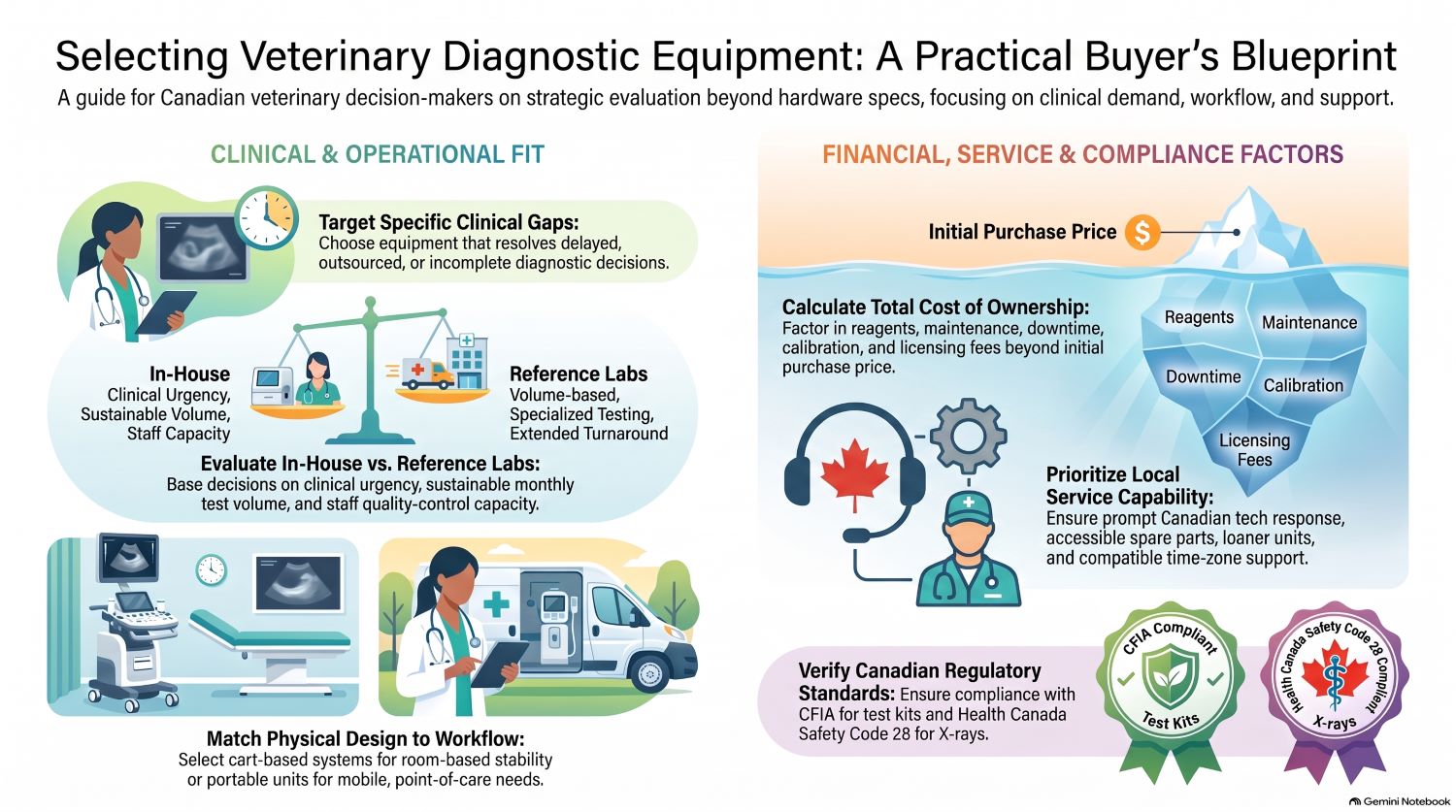
A veterinary clinic should begin by identifying which clinical decisions are currently delayed, outsourced or made with incomplete information. The purchase can then be evaluated according to how reliably it closes that specific gap.
A clinic that frequently transfers abdominal cases may benefit from diagnostic ultrasound. A high-volume practice that waits for routine bloodwork may prioritize an in-house analyzer. An emergency hospital may need both rapid imaging and laboratory capabilities because treatment decisions cannot always wait for reference-laboratory turnaround.
| Equipment category | Primary clinical role | Important buying criteria | Common operational demand |
|---|---|---|---|
| Ultrasound | Real-time soft-tissue, abdominal, cardiac and point-of-care imaging | Transducer selection, image quality, presets, portability and training | Operator education and consistent scanning protocols |
| Digital radiography | Evaluation of bones, lungs and other structures | Detector size, image acquisition speed, software and radiation safety | Room planning, quality control and provincial compliance |
| Hematology analyzer | Measurement and classification of blood cells | Species validation, sample volume, flagging and quality-control procedures | Reagents, controls and regular maintenance |
| Chemistry analyzer | Measurement of biochemical markers | Test menu, throughput, calibration and reagent storage | Consumables, quality control and waste management |
| Urinalysis equipment | Assessment of urine chemistry and sediment | Automation level, sample handling and result consistency | Cleaning, controls and correlation with microscopy |
| Endoscopy | Internal visualization and sample collection | Scope dimensions, image quality, reprocessing and accessory availability | Cleaning, disinfection and procedural training |
| Patient monitor | Continuous measurement of physiologic parameters | Parameter options, alarm design, species profiles and data storage | Sensor replacement, alarm configuration and staff competency |
A feature should only influence the buying decision if it improves a frequent clinical or operational task. A rarely used measurement mode may add cost without improving patient care, while a simple workflow improvement can create value during every examination.
Decide Which Diagnostics Belong In-House
Bringing testing in-house can shorten the time between examination, diagnosis and treatment. It also introduces responsibility for sample handling, equipment maintenance, reagent management, calibration and quality control.
The decision should be based on the complete testing process rather than turnaround time alone.
Clinical urgency
Tests used for unstable, anesthetized or emergency patients generally carry more time sensitivity than tests used for routine screening. Faster results are most valuable when they can change immediate treatment, referral or monitoring decisions.
Sustainable testing volume
Estimate the number of tests the clinic can realistically perform each month. Low volume may lead to expired reagents, inconsistent operator proficiency and a higher cost per reportable result.
Testing volume should be calculated by test type rather than by total patient visits. A clinic may see many appointments while performing relatively few tests suited to a specific analyzer.
Quality-control responsibilities
Point-of-care testing does not remove the need for laboratory discipline. Staff need documented procedures for sample collection, storage, instrument checks, controls, abnormal flags, maintenance and result review. Laboratory accreditation standards emphasize trained personnel, accurate sample tracking and properly calibrated equipment for both point-of-care and reference-laboratory testing.[1]
Reference-laboratory backup
In-house equipment should complement rather than completely replace external laboratory access. Referral testing may still be appropriate for confirmation, uncommon assays, pathology, culture or cases requiring specialist interpretation.
A clinic also needs a contingency plan for analyzer downtime, delayed reagent deliveries and results that do not agree with the patient’s clinical presentation.
Evaluate Veterinary Ultrasound as a Complete System
Ultrasound performance depends on the main unit, transducers, software, examination protocols and operator skill. Comparing consoles without considering the intended examinations can produce an expensive system that is poorly matched to the practice.
Buyers should define the expected applications before requesting a demonstration:
- Abdominal examinations
- Cardiac assessments
- Reproductive imaging
- Musculoskeletal applications
- Vascular assessment
- Point-of-care ultrasound
- Procedure guidance
- Small, large or exotic animal examinations
Transducer selection should reflect patient size, required penetration and the structures being examined. A probe suitable for deeper abdominal imaging will not necessarily provide the resolution or footprint needed for superficial structures or very small patients.
Cart-based systems generally provide larger displays, multiple active transducer ports and a stable room-based workflow. Portable systems are better suited to treatment areas, emergency departments, mobile practices and situations where imaging must travel to the patient.
The Mindray Vetus 7, for example, is a cart-based veterinary ultrasound system with a 21.5-inch display, a 13.3-inch touchscreen and four active transducer sockets.[2] The portable Vetus E7 main unit weighs approximately 6.6 pounds and is 1.7 inches thick, making it better suited to mobile or space-constrained use cases.[3]
These specifications describe workflow differences, not a universal hierarchy. The appropriate configuration depends on how and where the clinic expects to perform examinations.
Treat Patient Monitoring as a Workflow Decision
Multiparameter monitors consolidate several physiologic measurements on one interface. Depending on the configuration, those parameters may include electrocardiography, non-invasive or invasive blood pressure, oxygen saturation, temperature and capnography.
Monitor evaluation should begin with the procedures and patient populations the clinic handles. Important questions include:
- Which parameters are included in the quoted configuration?
- Are veterinary-specific sensors and accessories available?
- Can alarm limits be customized for different species and patient sizes?
- How clearly are alarms prioritized and displayed?
- Can trends be reviewed after a procedure?
- Is data transferred to a central monitoring or record system?
- How quickly can damaged sensors or sampling components be replaced?
Alarm flexibility matters because appropriate limits can differ by species, patient condition and stage of care. The Mindray ePM 12M Vet can store as many as 25 customized configurations with different alarm settings for individual patient types or species.[4]
A demonstration should include realistic interruptions, not just a controlled product overview. Staff should test how quickly they can start a new case, change a profile, respond to an alarm, review trends and clean the equipment between patients.
Compare Total Cost of Ownership, Not Purchase Price
The quoted equipment price represents only one part of the investment. Total cost of ownership includes every expense required to keep the system clinically useful.
Buyers should request a written breakdown of:
- Main equipment and required modules
- Transducers, probes, sensors and cables
- Computers, displays, printers or networking hardware
- Delivery and installation
- Initial and follow-up training
- Software licences and update fees
- Reagents, test kits, controls and other consumables
- Preventive maintenance
- Calibration and electrical safety testing
- Warranty coverage
- Service calls, travel and labour
- Replacement components
- Data storage or system-integration fees
- Decommissioning or disposal
Consumable dependency deserves particular attention. A competitively priced analyzer can become expensive if it relies on proprietary reagents with short shelf lives, minimum order quantities or limited distribution. Buyers should calculate cost per reportable result after accounting for controls, repeats, waste and expired materials.
Downtime also has a cost. Clinics may lose procedure capacity, send more tests to outside laboratories or transfer cases while equipment is unavailable. A service agreement should therefore be evaluated partly by how it limits operational disruption.
Service Capability Should Carry as Much Weight as Specifications
Veterinary diagnostic equipment requires support beyond the initial installation. Before purchasing, confirm who will respond when the system fails, where replacement parts are stored and what happens if an immediate repair is not possible.
A complete service discussion should address:
- Manufacturer authorization and technician training
- Geographic coverage within Canada
- Remote troubleshooting
- On-site response expectations
- Parts availability
- Preventive maintenance schedules
- Calibration documentation
- Software and firmware support
- Loaner or replacement equipment
- Coverage for accessories and transducers
- Support after the standard warranty expires
The warranty should identify what is covered, what is excluded and whether travel or shipping charges apply. Damage to a frequently handled transducer, sensor or cable may not be treated the same way as failure of the main unit.
Canadian buyers should also verify whether support is available in the clinic’s preferred language and time zone. These details become particularly important for rural, northern and mobile practices where sending equipment to a distant repair depot could create extended downtime.
Canadian Compliance Depends on the Type of Equipment
There is no single approval pathway covering every product described as veterinary diagnostic equipment. Applicable requirements depend on the equipment’s intended use, operating technology and location.
Infectious disease test kits
Veterinary diagnostic test kits represented for diagnosing infectious diseases in animals are regulated as veterinary biologics by the Canadian Food Inspection Agency’s Canadian Centre for Veterinary Biologics. These kits are evaluated for specificity, sensitivity, repeatability and reproducibility before licensing.[5]
That framework applies to the diagnostic test kit, not automatically to every analyzer, microscope or imaging system in a veterinary clinic. Buyers should confirm the regulatory status of the exact test and intended use rather than relying on a general statement that a product is “approved.”
Veterinary X-ray equipment
Veterinary X-ray equipment and its accessories sold in Canada must conform to the federal Radiation Emitting Devices Act and Food and Drugs Act requirements identified in Health Canada’s Safety Code 28.[6]
Installation, operation and occupational safety requirements may also be administered provincially or territorially. British Columbia’s occupational health and safety regulation, for example, specifically incorporates Safety Code 28 for veterinary X-ray equipment.[7] A clinic planning a radiography room should verify local shielding, registration, inspection, dosimetry and operator requirements before finalizing equipment or construction.
Electrical and facility requirements
Buyers should confirm that powered equipment carries the electrical approval or field-evaluation documentation required in the province where it will be installed. Voltage, receptacle, network and environmental requirements should be reviewed before delivery, particularly for equipment purchased internationally or moved between facilities.
The supplier should clearly document any site preparation requirements. Discovering that a room needs electrical, structural, ventilation or network changes after delivery can delay commissioning and increase the project cost.
Data Integration Can Determine Whether Equipment Saves Time
Diagnostic equipment creates more value when results are easy to associate with the correct patient and retrieve later. Manual transcription can introduce mismatched records, missing results and unnecessary administrative work.
Before purchasing, map the desired information flow:
- The patient and test are selected.
- Identifying information reaches the equipment.
- The examination or test is performed.
- Images or results are reviewed.
- The finalized record returns to the practice management or imaging system.
- The information remains accessible for follow-up, referral or audit.
Ask vendors whether the equipment supports the clinic’s practice information management system, picture archiving and communication system or preferred export format. Confirm whether integration is included, requires middleware or depends on a separate vendor.
Cloud-connected and AI-assisted platforms require additional scrutiny. Buyers should understand where data is stored, who can access it, how information is transmitted and whether the system continues to function during an internet outage. AI-generated interpretations should be treated as clinical decision support rather than an independent diagnosis, especially when training data and validation across species, breeds or imaging protocols are unclear.[8]
Demonstrate Equipment With Realistic Cases
A demonstration should reproduce the clinic’s normal working conditions as closely as possible. Marketing images and preset sample results reveal little about usability during a busy appointment or emergency.
Ask the vendor to demonstrate:
- Common examinations performed by the clinic
- Small, large and difficult-to-image patients
- Patient setup and record creation
- Probe, sensor or reagent changes
- Image and result optimization
- Abnormal result flags
- Alarm adjustment
- Report generation and export
- Cleaning and disinfection
- End-of-day shutdown and maintenance
- Recovery from a network interruption
- Access to service and technical support
Include veterinarians, technicians and the team members responsible for maintenance or information technology. Each role encounters different sources of friction.
A scored evaluation sheet can keep the final decision objective. Rate clinical performance, ease of use, staff confidence, integration, service, lifecycle cost and compliance documentation separately instead of allowing one impressive feature to dominate the purchase.
Veterinary Diagnostic and Monitoring Equipment From BOMImed
BOMImed supplies Canadian veterinary practices with Mindray veterinary ultrasound systems and multiparameter patient monitors, along with anesthesia, infusion and other clinical equipment. Its current veterinary imaging range includes the cart-based Vetus 7 and portable Vetus E7, while the ePM 10/12M Vet supports multiparameter patient monitoring.[9]
The company also provides installation, training, technical support and equipment service within Canada.[9] Keeping the equipment, training and maintenance relationship together can simplify accountability when a clinic is commissioning a new system or troubleshooting a problem.
Buyers should still evaluate each configuration against their patient mix, clinical services and workflow. The most advanced system is not automatically the best investment if a different configuration is easier for the team to use consistently.
A Practical Purchase Checklist for Canadian Clinics
Before approving a veterinary diagnostic equipment purchase, confirm that the clinic can answer each of the following:
- What recurring clinical decision will the equipment support?
- Which species, patient sizes and procedures must it accommodate?
- How many examinations or tests will the clinic realistically perform?
- Which accessories and software features are included?
- What training is provided for new and existing staff?
- How will competency be maintained?
- What calibration and quality-control procedures are required?
- Which consumables expire or require controlled storage?
- Can results integrate with current clinical systems?
- Where will patient data be stored?
- What Canadian, provincial or territorial requirements apply?
- Who provides service and where are parts located?
- What happens when the equipment is unavailable?
- What is the expected cost over its full service life?
The strongest purchase is not necessarily the system with the longest feature list. It is the system that gives the clinical team dependable information, fits the clinic’s daily processes and can be supported wherever the practice operates in Canada.
FAQ
What is the most important diagnostic equipment for a veterinary clinic?
The answer depends on the clinic’s case mix. General practices commonly rely on blood and urine testing, radiography and ultrasound, while emergency and referral facilities may require faster, more advanced or redundant diagnostic capabilities.
Is a veterinary patient monitor considered diagnostic equipment?
A patient monitor provides physiologic measurements that support assessment and clinical decisions, but it does not replace diagnostic imaging, laboratory testing or examination. Its primary role is continuous monitoring during anesthesia, recovery and critical care.
Should a veterinary clinic perform diagnostic testing in-house?
In-house testing is most valuable when rapid results can affect immediate treatment and the clinic has enough testing volume to maintain staff proficiency and manage consumables efficiently. Reference laboratories remain useful for specialized, confirmatory and lower-volume tests.
What should a clinic look for in a veterinary ultrasound system?
Evaluate image quality on representative patients, available transducers, veterinary presets, portability, reporting tools, data export, training and service. The best system should match the examinations the clinic intends to perform.
How often should veterinary diagnostic equipment be calibrated?
Calibration and maintenance intervals vary by equipment type, manufacturer instructions, usage and applicable requirements. The clinic should follow a documented schedule and retain service, calibration and quality-control records.
Can veterinary equipment purchased outside Canada be used in a Canadian clinic?
Imported equipment may require additional verification for electrical approval, regulatory conformity, warranty coverage, parts availability and local service. These issues should be resolved before purchase rather than after the equipment arrives.
What should be included in a veterinary equipment service agreement?
The agreement should define preventive maintenance, calibration, labour, travel, parts, response expectations, remote support, software updates and loaner availability. It should also identify exclusions and the process for obtaining service after hours.
Sources
- American Animal Hospital Association, “AAHA Standards of Accreditation,” 2025. aaha.org
- Mindray Animal Medical, “Vetus 7,” accessed 2026. mindrayanimal.com
- Mindray Animal Medical, “Vetus E7 Hand-Carried Ultrasound System,” accessed 2026. mindrayanimal.com
- Mindray Animal Medical, “ePM 12M Vet,” accessed 2026. mindrayanimal.com
- Canadian Food Inspection Agency, “Licensing Veterinary Diagnostic Test Kits in Canada,” 2024. inspection.canada.ca
- Health Canada, “Radiation Protection in Veterinary Medicine: Safety Code 28,” 1991. canada.ca
- WorkSafeBC, “OHS Regulation Part 7: Noise, Vibration, Radiation and Temperature,” accessed 2026. worksafebc.com
- American Animal Hospital Association, “AI Radiology Tools in Vet Med: Risks, Data Sets, and What’s Next,” 2025. aaha.org
- BOMImed, “Veterinary Equipment Canada,” updated 2026. bomimed.ca/veterinary-equipment-canada/