






Updated 5/13/2026
The effectiveness of a vital signs monitor lies in its ability to deliver accurate, quick, and reliable data. Modern devices are equipped with advanced technology to enhance usability, efficiency, and patient care.
A quick guide to what you’ll learn in this article. Click any section to jump directly to it:
- Key Features of Vital Signs Monitors
- Types of Vital Signs Machines
- The Importance of Monitoring Vital Signs
- Advanced Features in Modern Monitors
- How to Choose the Right Monitor
- Applications Across Healthcare
- Tailored for Different Patient Populations
- Training and Ease of Use
- Maintenance and Care
- Regulatory Standards and Compliance
- Role in Preventive Care
- Challenges and Solutions
- Sustainability in Healthcare Equipment
- Future Trends and Next-Gen Tech
- Why Choose BOMImed
- Case Studies
- Frequently Asked Questions
Key Features of Vital Signs Monitors
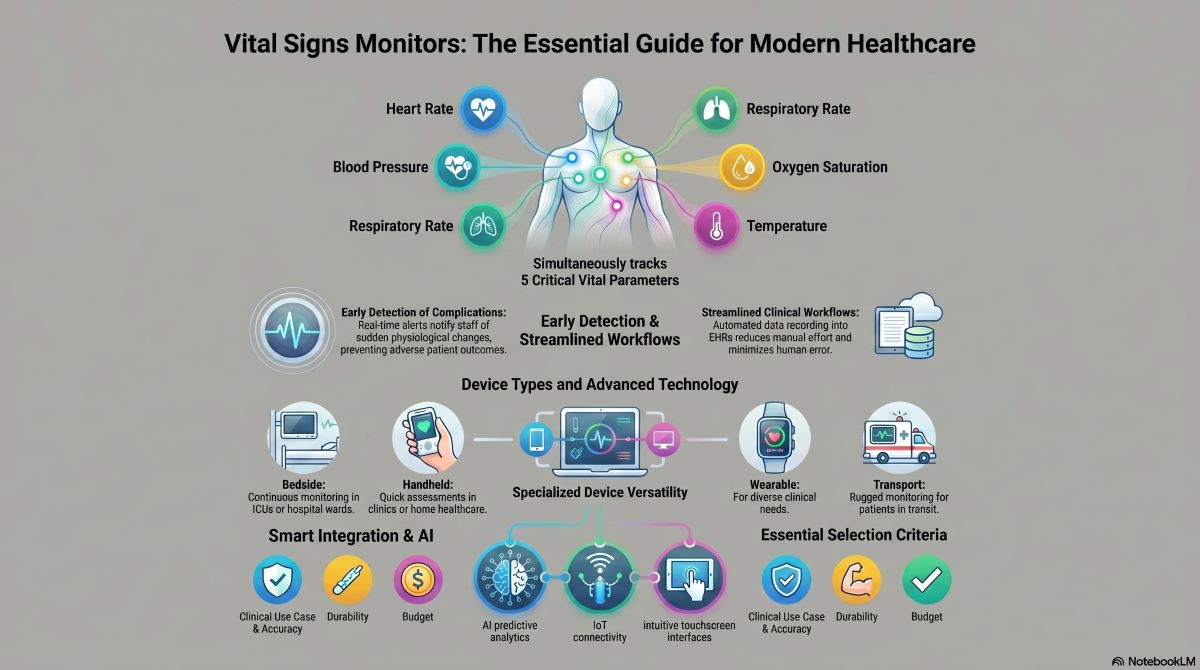
Modern vital signs monitors come equipped with features that make them indispensable in clinical environments. These features support clinical decision-making and improve workflows in every type of healthcare setting.
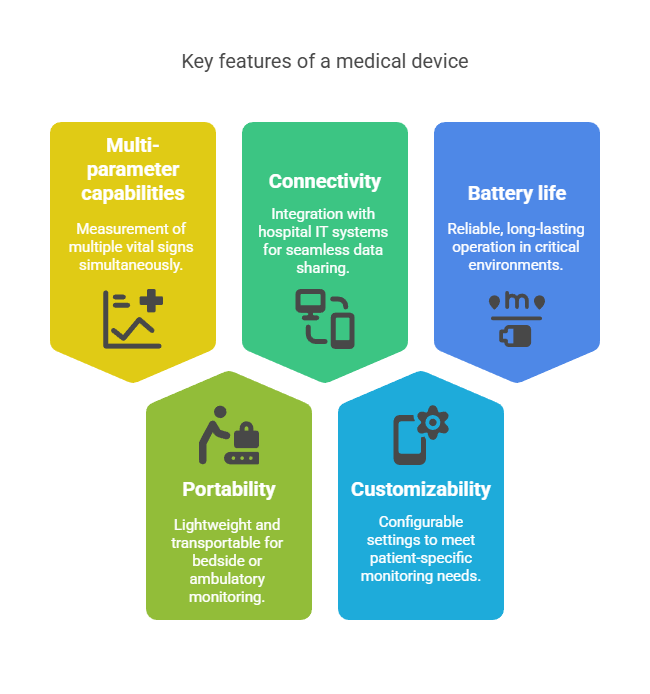
Multi-parameter Capabilities
Measurement of multiple vital signs simultaneously.
Portability
Lightweight and transportable for bedside or ambulatory monitoring.
Connectivity
Integration with hospital IT systems for seamless data sharing.
Customizability
Configurable settings to meet patient-specific monitoring needs.
Battery Life
Reliable, long-lasting operation in critical environments.
Types of Vital Signs Machines
Vital signs machines vary based on their design, purpose, and functionality, catering to specific clinical needs. Each category has been engineered for a particular setting — from quick spot checks in outpatient clinics to rugged transport-grade reliability inside ambulances.
| Type of Monitor | Description & Best Use |
|---|---|
| Handheld / Spot-Check Monitors | Compact and portable for quick assessments in clinics or on-the-go care. Commonly used in home healthcare settings. |
| Bedside Monitors | Designed for continuous monitoring in hospital wards or intensive care units. |
| Wearable Monitors | Often used in long-term care or outpatient settings, allowing patient mobility without sacrificing monitoring quality. |
| Transport Monitors | Rugged and reliable for monitoring patients during transit, such as in ambulances. |
The Importance of Monitoring Vital Signs
Accurate and timely monitoring of vital signs is crucial for managing patient health. These devices play a pivotal role in early detection, treatment decision-making, and patient safety.
- Early detection of complications: Alerts healthcare providers to critical changes in patient status.
- Streamlined workflows: Automated data recording reduces manual effort and error.
- Improved patient outcomes: Continuous monitoring supports better treatment and recovery.
Real-world example: A vital signs machine in an ICU might alert staff to a sudden drop in oxygen saturation, enabling immediate intervention and preventing adverse outcomes.
Advanced Features in Modern Vital Signs Monitors
Modern vital signs monitors incorporate cutting-edge technology to improve functionality and patient care. These features make today’s vital signs machines smarter, more efficient, and more adaptable to diverse healthcare environments.
| Advanced Feature | How It Benefits Care |
|---|---|
| AI Integration | Predictive analytics for trend detection and risk assessment. |
| Wireless & IoT Connectivity | Enables data sharing across devices and cloud platforms. |
| Touchscreen Interfaces | Simplifies operation and enhances usability for clinicians. |
| Energy-Efficient Designs | Ensures uninterrupted performance in critical care scenarios. |
How to Choose the Right Vital Signs Monitor
When choosing a vital signs monitor, it’s important to consider specific clinical and operational needs. The right device balances day-to-day usability with the technical depth your team needs across different patient populations.
| Consideration | What to Look For |
|---|---|
| Ease of Use | User-friendly interfaces and intuitive design for quick operation. |
| Accuracy | Precision in data measurement to ensure reliable readings. |
| Durability | Sturdy build for long-term usage in demanding healthcare settings. |
| Budget | Balance between cost-effectiveness and advanced features. |
Applications of Vital Signs Monitors Across Healthcare
Vital signs monitors are employed across various healthcare domains, catering to diverse patient populations. From emergency rooms to pediatric wards, these devices are foundational to safe, modern care delivery.
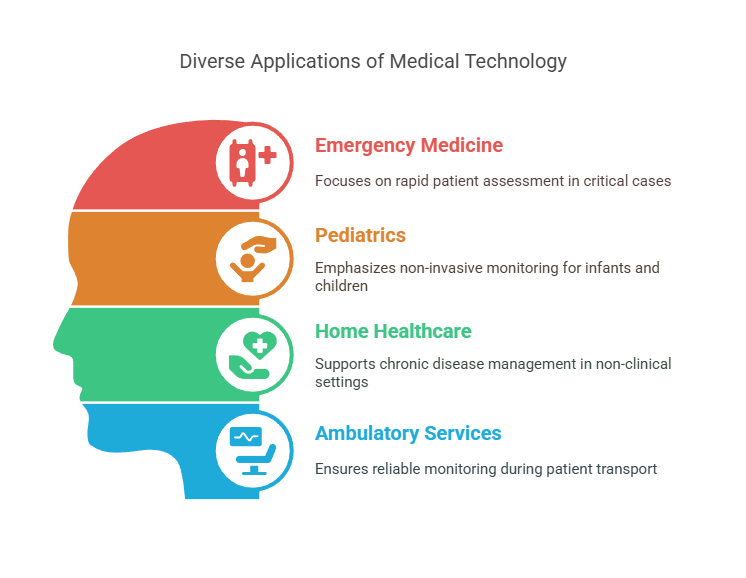
- Emergency Medicine: Rapid patient assessment in trauma or critical cases.
- Pediatrics: Monitoring infants and children with non-invasive options.
Tailored for Different Patient Populations
Different patient groups require unique monitoring approaches, and vital signs machines cater to these needs with tailored features.
| Patient Population | How Monitors Are Tailored |
|---|---|
| Neonatal Patients | Specialized monitors offer gentle, non-invasive measurements. Essential for NICUs to track premature babies’ fragile health. |
| Pediatric Patients | Machines designed to fit smaller anatomies ensure comfort and precision. Important for managing conditions like asthma or congenital heart defects. |
| Geriatric Patients | Continuous monitoring for elderly patients with chronic conditions like hypertension or heart disease. |
Training and Ease of Use
While modern vital signs monitors are designed for ease of use, training healthcare providers remains essential. Investing in proper training helps facilities get the most out of their equipment and protects patient safety.
Benefits of Staff Training
- Reduces user error and enhances operational efficiency.
- Familiarizes clinicians with advanced features like trend analysis or alarm customization.
- Supports compliance with safety protocols and regulatory requirements.
User-Friendly Design Features
- Touchscreen interfaces simplify navigation.
- Visual and auditory alarms help users prioritize critical data.
Proper training ensures that the full potential of vital signs machines is realized in clinical practice.
Maintenance and Care
To ensure the longevity and accuracy of vital signs monitors, regular maintenance is essential. A consistent maintenance routine minimizes downtime, extends device lifespan, and guarantees measurement reliability.
| Maintenance Task | Purpose |
|---|---|
| Scheduled Calibration | To maintain measurement precision. |
| Cleaning and Disinfecting | Per manufacturer guidelines, to prevent contamination. |
| Battery Checks | To ensure uninterrupted functionality. |
| Firmware Updates | To access the latest software features. |
Regulatory Standards and Compliance
Compliance with medical standards ensures the safety and effectiveness of vital signs monitors. Meeting these standards guarantees that the vital signs machine adheres to global benchmarks for accuracy and safety.
| Standard / Certification | Region / Purpose |
|---|---|
| FDA Approval | For US markets. |
| CE Marking | For European standards. |
| ISO 13485 Certification | Quality management in medical devices. |
Role in Preventive Care
Preventive care has become a cornerstone of modern medicine, and vital signs monitoring plays a vital role in early detection and disease prevention.
- Annual Check-Ups: Quick assessments during routine health visits.
- Remote Monitoring: Devices in home care settings detect changes in vital signs, prompting early medical intervention.
Challenges and Solutions in Vital Signs Monitoring
While vital signs monitors offer significant benefits, they also present challenges in implementation and operation. Recognizing these challenges early — and pairing each with a practical solution — helps facilities deploy monitoring technology successfully.
| Challenge | Recommended Solution |
|---|---|
| Cost Barriers | High-end models can be expensive for smaller facilities. Solution: Seek scalable options to balance budget and functionality. |
| Data Overload | Managing large volumes of patient data requires robust IT infrastructure. Solution: Invest in EHR systems with advanced analytics to streamline data management. |
| Maintenance | Regular calibration and updates are essential but often overlooked. Solution: Follow manufacturer recommendations for maintenance to ensure reliability. |
Sustainability in Healthcare Equipment
Sustainability is becoming a key focus in healthcare equipment design. These advancements align with the broader push toward greener healthcare systems.
- Recyclable Materials: Manufacturers are increasingly using biodegradable components.
- Energy Efficiency: Modern vital signs monitors consume less power without compromising performance.
- Extended Lifespan: Durable designs reduce the need for frequent replacements, lowering environmental impact.
Future Trends in Vital Signs Monitoring
The vital signs monitoring industry continues to evolve, driven by advancements in technology and changing healthcare needs. The next generation of vital signs monitors is defined by transformative technologies that are redefining patient monitoring, making healthcare more accessible and efficient.
Emerging Industry Trends
- Remote Monitoring Solutions: Expansion of telemedicine and wearable devices.
- AI and Machine Learning: Enhancing predictive capabilities and decision support.
- Sustainability Focus: Eco-friendly designs and materials for medical devices.
The integration of these innovations positions vital signs machines as cornerstones of modern healthcare.
Next-Generation Technologies
| Technology | Impact on Patient Care |
|---|---|
| Wearable Technology | Smartwatches and wearable monitors provide 24/7 tracking. |
| AI-Driven Insights | Predictive algorithms identify health risks based on trends. |
| Telehealth Integration | Remote patient monitoring systems deliver data directly to clinicians. |
| Biometric Authentication | Enhanced security features protect sensitive patient data. |
Why Choose BOMImed for Vital Signs Monitors
BOMImed offers an extensive range of vital signs monitors, catering to diverse clinical requirements. We are committed to providing healthcare facilities with premium vital signs machines that deliver accurate and reliable performance.
High-Quality Devices
Backed by trusted manufacturers.
Comprehensive Product Support
Including training and ongoing assistance for your team.
Competitive Pricing
Tailored to healthcare budgets of all sizes.
Innovation & Customer Satisfaction
A continued commitment to advancing patient monitoring technology.
Quality Assurance
Every device undergoes rigorous testing to meet clinical standards.
Wide Product Range
Solutions for hospitals, clinics, and home care settings.
Browse our vital signs monitor collection to find the right solution for your needs. Partner with BOMImed to elevate your patient care with the latest in vital signs monitoring technology.
Case Studies
Real-world deployments highlight the impact vital signs monitors have on patient outcomes across different care environments.
Case Study 1: ICU Patient Monitoring
An ICU patient recovering from surgery exhibited a sudden drop in oxygen saturation, detected by a bedside monitor. The real-time alert enabled the medical team to respond promptly, stabilizing the patient.
Frequently Asked Questions
Quick, direct answers to the most common questions about vital signs monitors and the readings they display.
What are vital signs monitors?
Vital signs monitors are medical devices that measure, display, and record a patient’s essential physiological data — typically heart rate, blood pressure, respiratory rate, body temperature, and oxygen saturation (SpO₂) — in real time.
They use non-invasive sensors such as blood pressure cuffs, pulse oximetry probes, ECG electrodes, and temperature probes to capture readings, then display the data on a screen for clinicians to interpret. Modern monitors also connect to hospital networks and electronic health records (EHRs) so that vital signs can be shared, charted, and alarmed across an entire care team.
Vital signs monitors are used in nearly every clinical setting, including:
- Intensive care units (ICUs) and operating rooms for continuous, high-acuity monitoring
- Hospital wards and step-down units for routine bedside observations
- Emergency departments and ambulances for rapid triage and patient transport
- Outpatient clinics and home healthcare for spot-check measurements
What are the 7 vital signs and their normal ranges?
The seven vital signs are body temperature, pulse rate, respiratory rate, blood pressure, oxygen saturation, pain level, and level of consciousness. The five “core” vital signs are followed by two extended indicators — pain and level of consciousness — that are often called the sixth and seventh vital signs.
Typical normal adult ranges are:
| Vital Sign | Normal Adult Range |
|---|---|
| Body Temperature | 36.1–37.2 °C (97.0–99.0 °F) |
| Pulse Rate (Heart Rate) | 60–100 beats per minute |
| Respiratory Rate | 12–20 breaths per minute |
| Blood Pressure | Below 120/80 mmHg (normal) |
| Oxygen Saturation (SpO₂) | 95–100% |
| Pain Level | 0 on a 0–10 scale (no pain) |
| Level of Consciousness | Alert & oriented (AVPU: “A”; GCS: 15) |
Normal ranges vary with age, fitness, pregnancy, and medical conditions, so individual baselines should always be considered. Pediatric and neonatal ranges differ significantly from the adult values shown above.
What are the 5 main vital signs?
The five main vital signs are body temperature, pulse rate (heart rate), respiratory rate, blood pressure, and oxygen saturation (SpO₂). Together they give clinicians a fast, reliable snapshot of how the body’s most critical systems are functioning.
Each one measures a different aspect of physiology:
- Body Temperature — reflects metabolic activity and can signal infection, inflammation, or hypothermia.
- Pulse Rate (Heart Rate) — the number of heartbeats per minute, indicating cardiovascular function.
- Respiratory Rate — the number of breaths per minute, reflecting lung function and oxygen demand.
- Blood Pressure — the force of blood against artery walls, expressed as systolic over diastolic (mmHg).
- Oxygen Saturation (SpO₂) — the percentage of oxygen-saturated hemoglobin in the blood, measured by pulse oximetry.
Some clinical settings add pain level as a “sixth vital sign” and level of consciousness as a “seventh,” but the five above are the universal core measurements found on virtually every vital signs monitor.
What are the three numbers on a vitals monitor?
The three numbers most prominently displayed on a vital signs monitor are typically heart rate (in beats per minute), blood pressure (systolic over diastolic in mmHg), and oxygen saturation or SpO₂ (as a percentage). On many spot-check monitors these are the three primary readings shown on the main screen.
Here’s what each number represents:
- Heart Rate (HR or PR) — usually shown in green, measured in beats per minute (bpm). Normal adult range is 60–100 bpm.
- Blood Pressure (NIBP) — displayed as two numbers, e.g. 120/80. The top number (systolic) is the pressure when the heart beats; the bottom number (diastolic) is the pressure between beats. A mean arterial pressure (MAP) may also appear in parentheses.
- Oxygen Saturation (SpO₂) — usually shown in blue or cyan as a percentage. Normal adult range is 95–100%.
On multi-parameter monitors used in ICUs or operating rooms, additional numbers may be displayed alongside these three, including respiratory rate, body temperature, ECG waveforms, and end-tidal CO₂.
Looking for the Right Vital Signs Monitor?
BOMImed offers Canada’s leading selection of Mindray vital signs monitors for every clinical setting.