







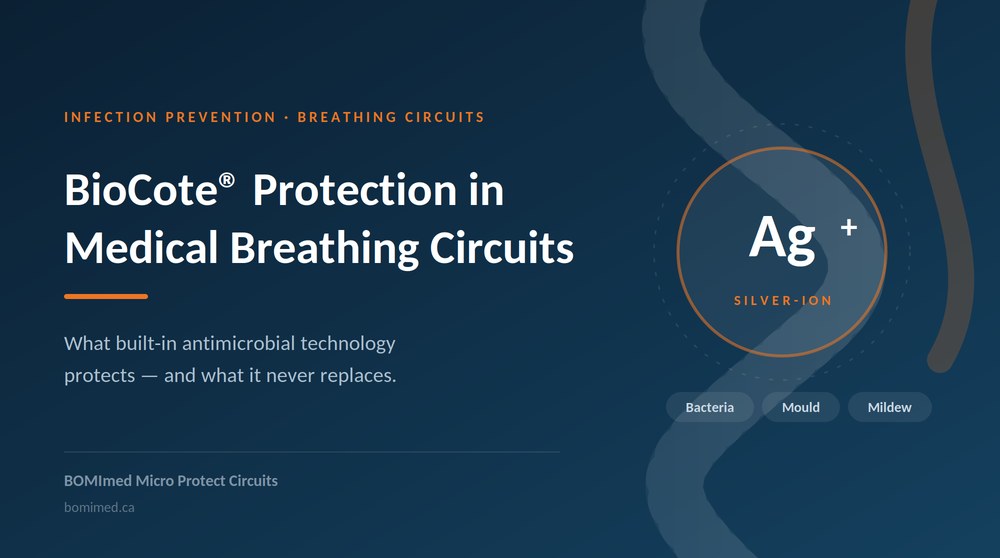
BioCote® protection is a built-in antimicrobial technology, not a filter and not a sterilization process. In BOMImed Micro Protect breathing circuits, a silver-based additive is incorporated into the circuit material during manufacturing, allowing it to work continuously on the product surface rather than functioning as a temporary spray or coating.[1]
The technology provides an additional layer of product protection in anesthesia and respiratory care. It does not sterilize the breathing circuit, filter the patient’s airway or replace the infection-prevention practices required in Canadian healthcare settings. BioCote protection uses silver ions to disrupt essential microbial functions and inhibit the growth and reproduction of microorganisms on treated product surfaces. In Micro Protect circuits, the technology helps protect the circuit from bacteria, mould and mildew. A properly rated airway filter, correct handling and standard infection-control practices are still required.[1]
Direct Answer: BioCote protection is a silver-ion antimicrobial additive built into the circuit material during manufacturing. It continuously inhibits bacteria, mould and mildew from growing on the treated circuit surface. It does not sterilize the circuit, does not filter respiratory gas, and does not replace filtration, hand hygiene, cleaning or single-patient-use requirements.
What BioCote Protection Means in Medical Equipment
BioCote protection is an antimicrobial additive incorporated into a product during manufacturing. The technology is intended to reduce microbial colonization on the treated material and limit problems associated with microbial growth, including staining, odours and material degradation.
This differs from a liquid disinfectant applied during cleaning. A disinfectant acts for a defined period under specified conditions. BioCote remains part of the manufactured material and works continuously during the product’s expected service life.[2]
Important distinction: product protection and patient protection are not the same thing.
- Product protection controls microbial growth on the treated circuit surface.
- Airway filtration creates a barrier within the respiratory gas pathway.
- Hand hygiene reduces transfer during equipment handling.
- Cleaning and disinfection remove contamination from reusable equipment and environmental surfaces.
- Clinical infection prevention combines these controls according to the patient, procedure and care environment.
BioCote protection contributes to this layered system but does not replace any other required control.
How Silver-Ion Antimicrobial Technology Works
Silver-ion technology makes a treated surface less hospitable to microbial survival and reproduction. When microorganisms contact the protected material, silver ions interact with multiple cellular processes.
Four microbial functions affected by silver-ion technology
Cell membranes
Silver ions can interfere with membrane integrity and normal transport functions.
Proteins and enzymes
Binding to microbial proteins can disrupt functions required for survival.
Cellular energy
Silver ions can interfere with processes microorganisms use to produce energy.
DNA replication
Disruption of genetic material can prevent microorganisms from reproducing.
Because the technology affects several microbial functions, it does not depend on a single point of action. BioCote reports that its silver additives can be incorporated into polymers, coatings, textiles and other materials without functioning as a visible surface layer.[3]
Clinical note: The additive used in a specific product must still be matched to the material and manufacturing process. Antimicrobial performance cannot be assumed solely because a product contains silver.
BioCote Protection and Airway Filtration Perform Different Jobs
An antimicrobial circuit and an airway filter should not be treated as interchangeable components. Each control answers a different clinical question, and neither one covers the other’s gap.
Respiratory Hygiene Controls: What Each One Establishes
| Control | Primary function | What it does not establish |
|---|---|---|
| BioCote-treated circuit | Inhibits microbial growth on treated circuit material | Sterility or filtration of respiratory gas |
| Bacterial/viral filter | Reduces microbial passage through the gas pathway | Antimicrobial protection across the entire circuit surface |
| HEPA filter | Provides high-efficiency particulate filtration | Surface disinfection |
| Heat and moisture exchanger (HME) | Conserves heat and humidity in the patient’s airway | Filtration unless specifically designated as an HMEF |
| HMEF | Combines heat and moisture exchange with filtration | Protection of every external equipment surface |
| Cleaning and disinfection | Removes soil and reduces microorganisms on applicable equipment | Continuous activity after the surface is recontaminated |
BOMImed states that Micro Protect Circuits require a properly rated airway filter. Recommended options include an Aquesure bacterial/viral filter or an Aquesure HEPA filter with humidification.[1]
Key takeaway: Filter selection must account for more than filtration efficiency. Resistance, internal volume, moisture performance, fluid resistance, patient size and breathing-system compatibility can all affect clinical suitability. These considerations matter most in paediatric and neonatal applications, where added dead space and resistance carry greater consequences.
What the “Up to 99.9%” Reduction Claim Actually Means
A percentage reduction should always be interpreted alongside its test conditions. The organism tested, starting concentration, exposure time, temperature, humidity and comparison surface can all affect the result.
ISO 22196:2011 specifies a method for measuring antibacterial activity on treated plastics and other non-porous surfaces. The standard was reviewed and confirmed as current in 2026.[4] It provides a controlled method for comparing treated and untreated materials, but its scope is limited to antibacterial activity under the specified laboratory conditions.
An ISO 22196 result does not independently demonstrate:
- That a product is sterile
- That all bacteria, viruses, fungi or spores are affected equally
- That the same reduction will occur immediately after contamination
- That identical performance will occur under every clinical condition
- That the product prevents healthcare-associated infections
- That cleaning, filtration or hand hygiene is unnecessary
Laboratory testing establishes whether a treated material demonstrates antimicrobial activity under defined conditions. Clinical value depends on how that material is incorporated into a safe device, how the device is handled and how it fits into the facility’s broader infection-prevention process.
Procurement note: The strongest evidence is testing performed on the finished product, or on a representative sample manufactured from the same material. Testing of an additive by itself does not automatically establish the performance of every product containing it.
Antimicrobial Does Not Mean Antiviral, Sterile or Self-Cleaning
Several related terms are routinely used as if they mean the same thing. They do not, and the difference matters in both procurement documentation and clinical communication.
Antimicrobial Terminology: Precise Definitions
| Term | What it actually means | What it does not mean |
|---|---|---|
| Antimicrobial | Activity against one or more types of microorganism | That every organism type is covered — this must be established by product-specific testing |
| Antibacterial | Activity specifically against bacteria | That the result extends to viruses or fungi without separate evidence |
| Bacteriostatic | Bacterial growth or reproduction is inhibited | That bacteria are killed |
| Bactericidal | Bacteria are killed under the test conditions | That the surface is sterile or stays sterile |
| Disinfected | A validated disinfection process has been completed | That bacterial spores have necessarily been destroyed |
| Sterile | Free from viable microorganisms to the level of a validated sterilization process | That antimicrobial material is inherently sterile |
| Self-cleaning | Soil and debris are removed without a separate process | Anything BioCote does — it does not remove blood, secretions or oils |
What BioCote protection does — and does not do
BioCote protection does
- Inhibit bacteria, mould and mildew growth on the treated circuit material
- Work continuously for the product’s expected functional life
- Sit inside the material as a manufacturing additive, not a sprayed-on coating
- Potentially limit odour, staining and material degradation
BioCote protection does not
- Sterilize the breathing circuit or support any sterile claim
- Filter the patient’s airway or replace a rated bacterial/viral filter or HMEF
- Authorize reuse of a circuit between patients or extend its approved use period
- Remove soil or secretions, or replace hand hygiene and cleaning
Most defensible position: For Micro Protect Circuits, the supportable interpretation is that BioCote protects the treated circuit material from microbial growth. Broader claims should be based on the product’s labelling and supporting evidence.
BioCote Protection Must Remain Part of a Layered Workflow
Canadian routine practices are expected for all patients in all healthcare settings. They include point-of-care risk assessment, hand hygiene, personal protective equipment when indicated, cleaning and disinfection of equipment, and appropriate management of respiratory secretions.[5]
Where BioCote protection fits in layered respiratory equipment hygiene
- BioCote-treated circuit surfaceInhibits microbial growth on the treated circuit material.
- Bacterial/viral filter or HMEFCreates a barrier within the respiratory gas pathway.
- Hand hygiene and safe handlingReduces transfer during setup, connection and manipulation.
- Cleaning and disinfectionRemoves contamination from reusable equipment and surfaces.
- Facility infection-prevention policyCombines controls by patient, procedure and care setting.
BioCote adds one layer to this system. It does not replace any of the others, and it does not sterilize the circuit.
A practical workflow for antimicrobial breathing circuits should include the following.
Before Use
- Confirm that packaging is intact.
- Select the correct circuit configuration for the patient and application.
- Verify compatibility with the anesthesia machine or ventilator.
- Install the required bacterial/viral filter or HMEF.
- Perform hand hygiene before handling clean patient-contact components.
- Complete all required breathing-system checks.
During Use
- Minimize unnecessary circuit disconnections.
- Avoid placing connectors or patient-contact components on contaminated surfaces.
- Handle condensate according to facility procedures and equipment instructions.
- Replace damaged, visibly contaminated or malfunctioning components as directed.
- Perform hand hygiene before and after circuit manipulation.
After Use
- Follow the circuit’s single-patient-use designation and change requirements.
- Dispose of used components through the facility’s appropriate waste stream.
- Clean and disinfect reusable equipment that may have been contaminated during use.
- Prevent used circuits from contacting clean supplies or equipment.
Key takeaway: The presence of BioCote does not authorize reuse between patients or extension beyond the manufacturer’s approved use period.
How BioCote Protection May Support Product Longevity
Microbial colonization can contribute to odours, staining and material deterioration. By inhibiting microbial growth, built-in antimicrobial technology may help preserve the cleanliness and integrity of the treated product during its authorized use.[2]
This carries potential operational and environmental value. BOMImed lists extended product life, regrind waste plastic and reduced plastic use among the Micro Protect circuit’s features.[1]
Important limitation: Antimicrobial protection should not be used to create an arbitrary circuit-change schedule. Any extension of use must remain within the product’s instructions, patient-specific requirements and facility infection-prevention policy. Sustainability claims should also account for the full configuration, including filters, sampling lines, connectors, packaging and disposal practices.
Questions to Ask When Evaluating an Antimicrobial Circuit
A procurement review should examine both antimicrobial evidence and respiratory performance. The antimicrobial percentage is one input to the decision, not the decision itself.
Antimicrobial Evidence
- Was testing conducted on the finished product, or only on the raw additive?
- Which organisms and strains were tested?
- What standard and exposure period were used?
- What was the untreated control material?
- Is the reported result an average, maximum or minimum reduction?
- Has antimicrobial performance been evaluated after manufacturing and storage?
Clinical Suitability
- Is the circuit intended for anesthesia, ventilation or both?
- Is the design heated or non-heated?
- Which patient sizes and tidal-volume ranges are supported?
- Which filters, HMEFs and connectors are compatible?
- What are the circuit’s resistance and compliance characteristics?
- What configurations can be customized?
- What is the approved duration and single-patient-use designation?
Operational Fit
- Can staff identify the antimicrobial circuit easily?
- Are compatible filters consistently available?
- Does the setup align with existing clinical workflows?
- Are disposal and replacement procedures clear?
- Can the supplier provide technical documents and training?
- Do sustainability claims reflect the facility’s actual use and waste patterns?
BOMImed Micro Protect Circuits and Compatible Filtration
An antimicrobial circuit only performs as intended when it is paired with correctly rated filtration. BOMImed supplies both halves of that pairing.
Micro Protect Circuits
Breathing circuits manufactured with a BioCote silver additive incorporated into the circuit material, protecting the treated surface against bacteria, mould and mildew. Product features include extended product life, regrind waste plastic and reduced plastic use. A properly rated airway filter is required.[1]
Aquesure Bacterial/Viral Filters
Airway filtration for the respiratory gas pathway — the control that a BioCote-treated circuit surface does not provide. Recommended by BOMImed for use with Micro Protect Circuits.[1][6]
Aquesure Filter Humidifiers
HEPA filtration combined with humidification, listed by BOMImed as a compatible option where humidification is clinically indicated alongside high-efficiency particulate filtration.[1][6]
Aquesure Heat Moisture Exchangers
Heat and moisture conservation for the patient’s airway. Note that an HME provides filtration only where the device is specifically designated as an HMEF.[7]
Clinical note: Confirm resistance, internal volume, moisture performance and patient-size suitability when matching a filter to a circuit, particularly in paediatric and neonatal applications. Browse the full breathing circuits and filters ranges.
Built-In Protection Has the Most Value When Its Role Is Clear
BioCote protection gives BOMImed Micro Protect breathing circuits an active surface property that conventional untreated circuit material does not provide. The technology continuously inhibits microbial growth on the protected material and may support product cleanliness, integrity and responsible material use.
Its value is strongest when clinical teams understand its boundaries. BioCote controls microbial growth on the treated circuit surface. The filter controls the respiratory pathway. Healthcare workers control equipment handling. Facility procedures control the broader care environment. Combining these distinct functions creates a more complete and more defensible approach to respiratory equipment hygiene.
For related reading, see Anti Microbial Technology Helps Reduce Microbial Growth on Medical Products and Antimicrobial Connectors for Medical Systems.
Common Misunderstandings About BioCote Protection
BioCote makes the circuit sterile.
It does not. Sterility requires a separately validated sterilization process and an applicable sterile product claim.
The circuit no longer needs an airway filter.
Incorrect. BOMImed requires a properly rated airway filter with Micro Protect Circuits.[1]
BioCote eliminates cross-contamination.
The technology can reduce microbial levels on treated material, but it cannot eliminate every transfer pathway. Hands, connectors, filters, nearby equipment and environmental surfaces all remain relevant.
The technology works equally against every microorganism.
Performance varies by organism and test conditions. Antibacterial evidence should not automatically be applied to viruses, fungi or bacterial spores.
The circuit can be shared between patients.
Antimicrobial protection does not change the product’s patient-use designation.
Routine infection-control procedures are no longer needed.
BioCote is a supplemental product feature. Hand hygiene, proper filtration, safe handling and applicable cleaning procedures all remain necessary.
FAQ: BioCote® Protection
What is BioCote protection?
BioCote protection is antimicrobial technology incorporated into a material during manufacturing. It continuously inhibits microbial growth on the treated product surface, rather than acting for a limited period like an applied spray or coating.
How does BOMImed use BioCote technology?
BOMImed incorporates a BioCote silver additive into Micro Protect breathing circuits to help protect the circuit material from microbial colonization.[1]
Does BioCote kill MRSA and E. coli?
BOMImed identifies MRSA and E. coli among the microorganisms against which its Micro Protect circuit material is protected.[1] Actual reductions depend on the test conditions and product-specific evidence.
Does a Micro Protect circuit still need a filter?
Yes. BOMImed specifies that a properly rated airway filter is required, and recommends compatible Aquesure bacterial/viral or HEPA filtration options.[1]
Can BioCote-protected circuits be reused between patients?
No. BioCote protection does not authorize cross-patient reuse. Circuits must be used, changed and discarded according to their labelling and facility procedures.
Does BioCote replace cleaning and hand hygiene?
No. BioCote reduces microbial growth on treated surfaces but does not remove dirt or contamination. Routine infection-prevention practices remain necessary.[3]
How long does BioCote protection last?
Because the technology is incorporated into the material, it is designed to remain active for the product’s expected functional life. That does not extend the circuit beyond its approved clinical-use period.[2]
Is antimicrobial the same as antiviral?
No. Antimicrobial is a broad term covering activity against one or more types of microorganism. Antibacterial evidence does not automatically demonstrate activity against viruses, fungi or bacterial spores — that requires separate, product-specific testing.
Sources
- BOMImed, “Micro Protect Circuits,” 2026. bomimed.ca/product/micro-protect-circuits/
- BioCote, “BOMImed Antimicrobial Breathing Circuits,” 2025. biocote.com
- BioCote, “Antimicrobial Technology FAQs,” 2024. biocote.com/frequently-asked-questions/
- International Organization for Standardization, “ISO 22196:2011 — Measurement of Antibacterial Activity on Plastics and Other Non-Porous Surfaces,” confirmed 2026. iso.org/standard/54431.html
- Public Health Agency of Canada, “Routine Practices and Additional Precautions for Preventing the Transmission of Infection in Healthcare Settings,” 2017. canada.ca
- BOMImed, “Aquesure Filters,” 2026. bomimed.ca/product/aquesure-filters/
- BOMImed, “Aquesure Heat Moisture Exchangers,” 2026. bomimed.ca/product/aquesure-heat-moisture-exchangers/