




Portable ultrasound systems have become central to modern veterinary practice. Their role extends across companion animal clinics, mixed animal operations, field service environments, and specialty care. The best portable veterinary ultrasound machine is one that delivers strong imaging clarity, consistent performance across species and tissue types, streamlined workflows, and physical durability suitable for clinical mobility. Reliability, ease of interpretation, and ergonomic handling shape real-world diagnostic outcomes far more than technical specifications alone.
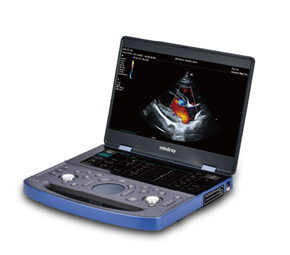
The Mindray Vetus E7, offered through BOMImed, is built to address the clinical realities that veterinarians face each day. It is engineered to provide imaging precision in both routine evaluations and advanced diagnostic work while minimizing strain and inefficiency during scanning. The system is designed around a veterinary-specific workflow rather than adapting from a general human ultrasound platform, giving it distinct advantages in use, handling, and interpretation.
Clinical Value in Portable Veterinary Ultrasound
Clinical ultrasound value is measured by image quality, consistency, and the ease with which clinicians can generate and interpret diagnostic information. When evaluating a portable system, veterinarians commonly prioritize:
- Clarity of soft tissue differentiation
- Depth and penetration for larger or thick-coated patients
- Sensitivity for small structures and subtle motion
- Workflow efficiency during frequent examinations
- Physical portability and ergonomic design
A portable ultrasound should not reduce diagnostic capability compared to a larger stationary unit. Instead, it should maintain resolution and scanning flexibility across a broad range of anatomical regions and species. The ability to move seamlessly between abdominal, cardiac, musculoskeletal, and reproductive exams is essential in a veterinary setting where patient types vary throughout the day.
The Vetus E7 is designed to deliver this level of cross-disciplinary performance in a lightweight, field-ready format.
Imaging Performance and Diagnostic Confidence
High-quality diagnostic ultrasound requires stable image formation with minimal noise and precise tissue contrast. The Vetus E7 provides consistent clarity that supports confident interpretation even in difficult imaging environments. The system responds well to a range of tissue densities, enabling accurate visual differentiation in both deep and superficial regions.
Veterinarians often need to capture images of small moving anatomical structures, fluid boundaries, or minor lesions. The Vetus E7 maintains resolution in real time without requiring excessive adjustment. This reduces the risk of diagnostic uncertainty, particularly during cardiac and abdominal evaluations where rapid tissue movement can affect visibility.
Because the system is built specifically for veterinary use, its presets and imaging modes align with common clinical scenarios, reducing time spent configuring manual settings. The scanner’s adaptability is especially effective when performing back-to-back exams across different patient sizes, allowing clinicians to shift quickly from small animal to large animal imaging without significant recalibration.
Workflow Efficiency and Daily Use Advantages
In clinical practice, workflow determines whether diagnostic equipment accelerates or slows patient care. A portable ultrasound system should reduce procedural friction and allow clinicians to remain focused on interpretation rather than adjustment or re-positioning challenges.
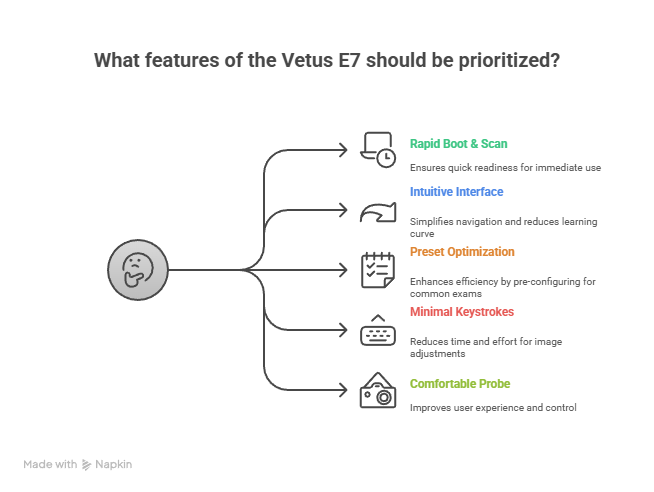
The Vetus E7 supports this by prioritizing:
- Rapid boot and scan readiness
- Intuitive interface navigation
- Preset optimization for common exam types
- Minimal keystrokes to achieve image adjustments
- Comfortable probe maneuvering and angle control
Its software interface is developed to minimize repetitive input patterns. Image optimization tools operate smoothly without noticeable delays, maintaining momentum during scanning sessions. These time efficiencies compound over the course of a clinic day, particularly in high-volume practices or field-based workflows.
In addition, the mobility of the system allows veterinarians to bring diagnostic imaging directly to the patient, supporting stress reduction for animals and improved workflow continuity during treatment planning.
Ergonomics and Physical Design for Mobile Veterinary Practice
Portability in veterinary ultrasound involves more than weight; it includes how comfortably the device can be held, transported, maneuvered, and positioned during an examination.
The Vetus E7 is engineered to reduce operator strain. Its form factor supports handheld stability without compromising probe movement precision. The physical build withstands repeated relocation within clinics, between facilities, or into field environments.
Key physical design considerations include:
- Stable center of gravity for single-hand control
- Durable outer casing resistant to routine clinical wear
- Probe options designed for both fine and deep imaging
- Cable routing that keeps scanning movements unobstructed
This design reduces operator fatigue, supporting longer scanning sessions without performance decline. Veterinary professionals who perform frequent imaging often report that ergonomic refinement has as much impact on clinical outcomes as imaging hardware itself.
Multi-Species Adaptability and Clinical Range
Veterinary ultrasound systems must function across diverse anatomical structures and physiologies. The Vetus E7 is built for consistent use in:
- Companion animal medicine (canine, feline)
- Equine practice (soft tissue, tendon, abdominal, cardiac)
- Bovine and livestock medicine (reproductive and general examination)
- Exotic and small mammals where fine detail is essential
Its imaging modes and transducer options are tuned to support this range without sacrificing clarity or requiring frequent manual recalibration.
Different species present different scanning challenges—dense musculature, variable thoracic structure, thicker adipose layers, and movement sensitivity. The Vetus E7 maintains resolution and contrast across these variables, supporting accurate interpretation regardless of setting.

Reducing Patient Stress and Improving Exam Experience
Portable ultrasound allows imaging to be performed in environments where the patient is most comfortable. Reduced stress improves the ability to obtain clear imaging without sedation in many cases, particularly with companion animals or livestock sensitive to transport or restraint.
The Vetus E7’s rapid acquisition and consistent clarity help shorten overall handling time. Minimizing exam duration contributes to better patient cooperation and supports more natural physiological imaging conditions.
This is especially relevant in cardiac examinations, where anxiety can meaningfully alter the presentation of subtle functional patterns. The ability to perform imaging in a familiar space, quickly and efficiently, strengthens diagnostic reliability.
Integration Into Clinical Decision-Making
A portable veterinary ultrasound system must integrate smoothly with the broader diagnostic and record-keeping workflow. The Vetus E7 supports efficient data transfer and structured storage, simplifying case documentation and follow-up analysis.
Clinicians benefit from the ability to reference archived scans without delay, and to compare images over time to assess treatment response or disease progression. The platform’s software environment is built to streamline this documentation process without imposing unnecessary complexity.
This level of integration is particularly useful in multi-clinician practices where continuity of care depends on consistent image quality and shared diagnostic interpretation.
Why the Mindray Vetus E7 Represents a Strong Choice for Clinical Portability
The Vetus E7 is centered around veterinary practice requirements rather than adapted from human clinical systems. This foundation influences the entire scanning and interpretation experience. The system is structured for clarity, efficiency, and adaptability across cases, supporting day-to-day practicality as well as advanced diagnostic demands.
Veterinarians who require a portable ultrasound that does not compromise on imaging reliability benefit from this alignment. It supports confident clinical decision-making while maintaining workflow momentum, patient comfort, and physical ease of operation.
BOMImed provides the Vetus E7 with professional support, ensuring that veterinarians can integrate the system effectively into active practice environments.
Advanced Imaging Modes and Clinical Adaptability
A portable ultrasound system intended for veterinary practice must support a wide range of imaging modes to suit different diagnostic objectives. The needs of a cardiac evaluation differ significantly from an abdominal organ assessment, tendon visualization, or reproductive confirmation. The Mindray Vetus E7 offers a mode configuration designed to provide meaningful visual clarity rather than simply adding technical options. Its imaging tools are structured to support interpretation, not complexity.
Cardiac evaluation requires stable real-time motion tracking, especially in small and fast-beating hearts. The Vetus E7 maintains image coherence while preserving the natural rhythm of the organ, enabling veterinarians to assess chamber size, wall thickness, and valve motion without delay or artifact. This allows for more confident identification of pathological variations and more reliable monitoring of progressive disease.
Musculoskeletal examinations also benefit from the system’s spatial detail. Tendons, ligaments, and joint capsules require fine structural delineation to detect subtle injury patterns. The Vetus E7’s image formation prioritizes edge clarity, helping clinicians determine the severity and location of fiber disruption, fluid accumulation, or degenerative change. In sports medicine and equine performance care, this level of detail influences treatment decisions and rehabilitation timelines.
Abdominal imaging demands depth penetration and soft tissue contrast. The system maintains balanced gain and contrast control in these deeper fields, preserving structural identification without generating excessive grain or shadowing. The result is a clear visual pathway from superficial tissue to deeper organ structures, improving the accuracy of diagnostic interpretation.
Reproductive imaging benefits from clear fetal visualization and uterine assessment. The Vetus E7 supports smooth transitions between gestational monitoring, ovulation assessment, and general reproductive system scans, enabling veterinarians to monitor breeding progress with minimal effort. This helps clinics provide consistent reproductive care whether working with companion animals, livestock, or mixed practice environments.
Role in Field Service and Mobile Veterinary Care
Mobile veterinary work requires diagnostic tools that can function reliably beyond clinic walls. Field service veterinarians must be able to evaluate patients in barns, stables, farm settings, or client homes. Ambient lighting, patient movement, environmental unpredictability, and time constraints can influence image quality and workflow.
The portable design of the Vetus E7 supports this aspect of veterinary practice by minimizing setup requirements and maintaining stable image performance even in less-than-ideal conditions. The system’s design allows it to be positioned close to the patient regardless of space limitations, reducing the need for repositioning during examinations.
In livestock or equine practice, where the patient may be large and movement unpredictable, the stability of probe contact and the system’s rapid image response become crucial. The Vetus E7 maintains visual stability even when movement is present, supporting more efficient scanning and reducing the need for repeat examinations.
This reliability strengthens the relationship between veterinarian and client by ensuring that diagnostic decisions can be reached promptly. Mobile care becomes more efficient, and treatment plans can be initiated without requiring additional facility-based imaging.
Learning Curve and Clinical Integration
Diagnostic imaging proficiency involves both technical control and interpretive skill. While training and experience are key to interpretation, the structure of the ultrasound interface influences the learning curve. A system that requires extensive manual adjustment can slow training and introduce variability in scan outcomes.
The Vetus E7 is built to minimize unnecessary complexity. Its presets and automated optimization functions allow clinicians to achieve clear images early in their learning process. This reduces frustration and accelerates the ability to perform consistent examinations.
For experienced practitioners, the system offers control depth without forcing constant manual input. Adjustments can be made quickly during scanning, and image updates occur in real time. This maintains scanning rhythm and reduces cognitive load during interpretation.
When a team of veterinarians or technicians works within the same practice, a system that supports consistent imaging outcomes helps maintain diagnostic continuity. The Vetus E7’s workflow-centered software and image standardization support collaborative case review and ongoing patient monitoring.
Maintenance, Support, and Long-Term Durability Considerations
Veterinary equipment must withstand frequent handling, transport, and routine cleaning. A portable ultrasound system is often moved several times per day, positioned at different exam heights, and used across various patient settings. Durability is therefore essential to maintain long-term reliability.
The Vetus E7 is structured with a stable core housing, reinforced casing contact points, and probe integration designed for repeated connection and disconnection. Its construction supports sustained use without drift in imaging performance. Maintenance is simplified through accessible system checks and streamlined cleaning surfaces that accommodate veterinary sanitation standards.
Support also plays a meaningful role in long-term equipment value. BOMImed provides clinical and technical support tailored to veterinary environments, ensuring that practices receive guidance on optimal system integration and continued performance. This contributes to the overall stability of diagnostic workflows and reduces the likelihood of operational disruption.
Strategic Investment in Veterinary Imaging Capability
The decision to invest in a portable veterinary ultrasound machine affects clinical practice, patient care capability, and the efficiency of diagnostic decision-making. The value of the system is measured not simply in specifications but in how reliably it supports clinical confidence, workflow rhythm, patient comfort, and inter-practitioner communication.
The Mindray Vetus E7 aligns with these needs by offering:
- Clear, stable imaging across species and anatomy
- Reduced scanning time and minimized operator strain
- Efficient data handling and consistent case documentation
- Reliable functionality in both clinic and mobile environments
Clinics benefit from a system that integrates into existing workflows and enhances diagnostic accuracy without increasing operational complexity. The Vetus E7 supports both immediate decision-making and long-term patient monitoring, making it a strong foundation for expanding imaging services within a veterinary practice.
FAQs
What defines the best portable veterinary ultrasound machine?
The best system balances imaging clarity, workflow efficiency, portability, durability, and clinical versatility across species and exam types.
Is portability achieved without reducing image quality?
Yes. A well-engineered veterinary-specific portable system maintains diagnostic resolution comparable to larger units.
Can one system support small and large animal applications?
The Vetus E7 is designed to support varied species with preset optimization and adaptable imaging modes.
How does portable ultrasound improve patient care?
It reduces transportation stress, supports quicker diagnostic decisions, and integrates directly into treatment workflows.
Is veterinary-specific engineering important?
Yes. Veterinary physiology, patient positioning, and scan patterns differ significantly from human medicine. A veterinary-centered design improves practical application.